AI didn’t enter your enterprise through one door
See how AccuroAI discovers every AI tool and agent, redacts sensitive data in line, and blocks risky agent actions before they reach your systems.

Ratings as of Aug 7, 2026. Gartner® and Peer Insights™ are trademarks of Gartner, Inc. and/or its affiliates. All rights reserved. Gartner Peer Insights content consists of the opinions of individual end users based on their own experiences, and should not be construed as statements of fact, nor do they represent the views of Gartner or its affiliates.
Five problems.
One control plane.
The risks converge faster than point tools can. AccuroAI covers all five with one policy engine and one audit trail.
One platform. Every surface.
Workforce tools, autonomous agents, local endpoints. AccuroAI covers all three.
One console. However you enter.
Whichever product you start with, this is where you land: one dashboard, one policy engine, one audit trail across governance, agents, and every device.
The first day AI becomes measurable.
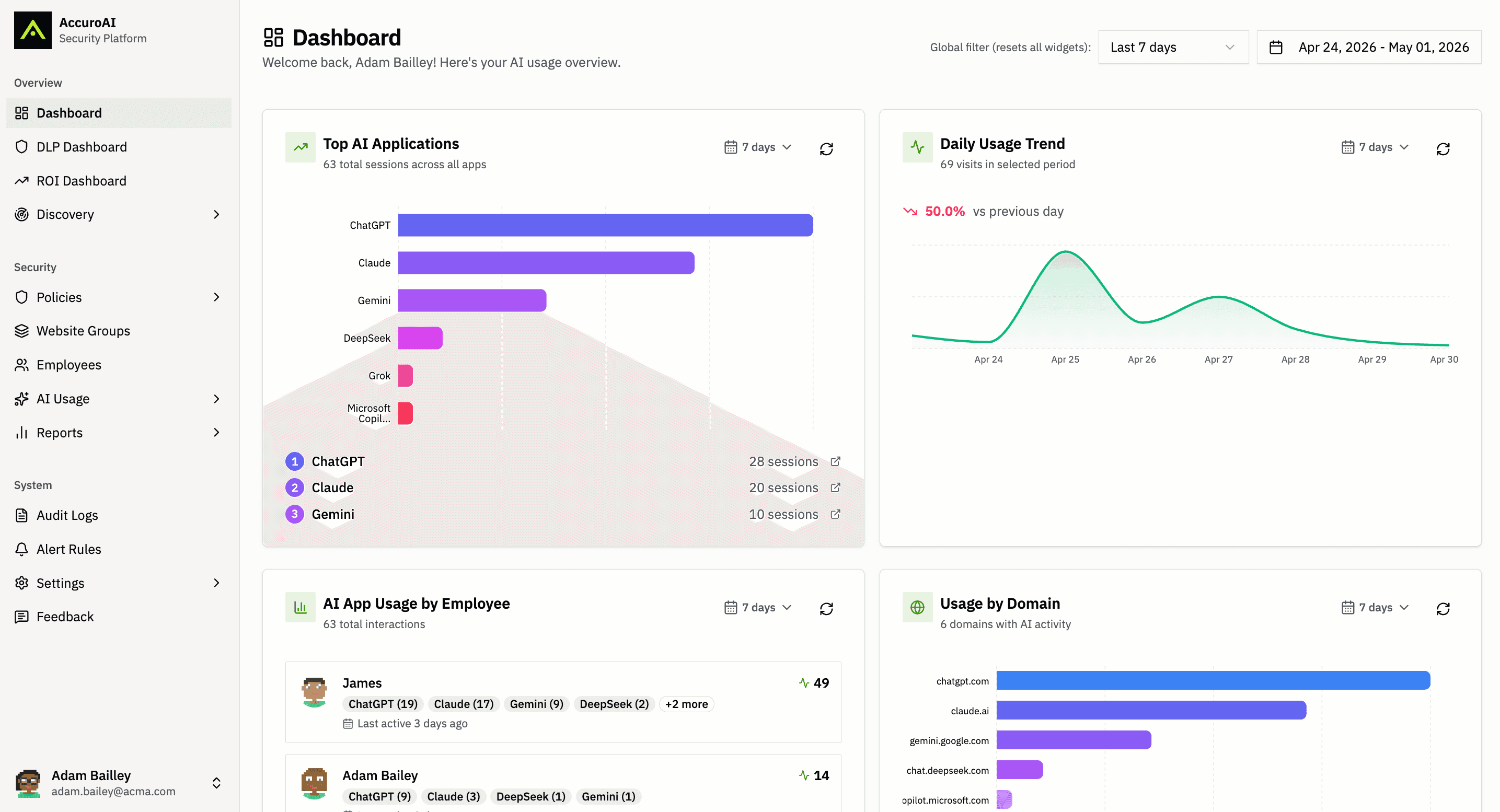
Real-time visibility across every AI interaction, user, and application. The moment AccuroAI is live.
Free guides. The latest research.
The field guide for security leaders: operating model, frameworks crosswalked, benchmarks, and a ready-to-send vendor RFP.
The state of shadow AI, DLP, and agent governance, with a 90-day implementation roadmap.
Canada has no AI statute, and as of early October 2026 none is before Parliament. AIDA lapsed with Bill C-27, and its replacement, Bill C-36, is a privacy bill that has had first reading only. That does not leave enterprise AI unregulated. We read PIPEDA, Quebec's Law 25, the privacy regulators' OpenAI findings and OSFI Guideline E-23, and set out what applies today, what has a fixed date, and why the work starts with an inventory.
The UK has no AI statute, so the UK GDPR as amended by the Data (Use and Access) Act 2025 is the binding regime. Since 5 February 2026, Articles 22A to 22D allow significant decisions with no human involved if four safeguards are in place, with tighter rules for special category data. Since 30 September 2026 the regulator is the Information Commission. We read the Act and both commencement regulations and set out what changed, which guidance is out of date, and what to evidence.
Since 30 September 2026, an Italian civil court hearing a damages claim over the use of an AI system can order production of evidence on how the system worked, including AI Act logs and oversight documentation. A party that fails to comply without a justified reason can see the claimant's facts treated as admitted. We read Legislative Decree 160/2026 and Law 132/2025 in the Gazzetta Ufficiale and set out what they require, what they do not, and what to log and keep.