AccuroAI
Book a demo
← Blog·Shadow AI11 min read

Shadow AI in Higher Education: A Practical Plan for Universities

Shadow AI in higher education is students, faculty, staff and researchers using AI tools the university has not approved, often on personal accounts. The practical plan is to license and announce approved tools, say which data may go where, and enforce on university-managed devices and institutional accounts. We read FERPA's regulations and the Department of Education's guidance to explain why staff pasting student records into personal AI accounts is a risk to assess.

S
Sofia Reyes
Head of Compliance
Nov 2, 2026

Shadow AI in higher education is students, faculty, staff and researchers using AI tools the university has not approved, often on personal accounts. A practical plan: license and announce approved tools, say which data may go where, enforce on university-managed devices and institutional accounts, and assess staff pasting student records into personal AI accounts as a FERPA risk.

A campus is not a company with more people in it. Four groups with different rules share one identity system, many laptops belong to the people carrying them, and the AI tool the university pays for often sits one tab away from a free personal account on the same product.

Our companion piece on shadow IT vs shadow AI covers which classic controls carry over. This is the campus version.

Last verified: 2 November 2026, against the eCFR text of 34 CFR Part 99 (current to 29 October 2026), Department of Education guidance on studentprivacy.ed.gov, a National Cancer Institute notice, and Google's and Microsoft's own pages. OpenAI's and EDUCAUSE's pages did not load for us, so we cite neither and use no survey figures.
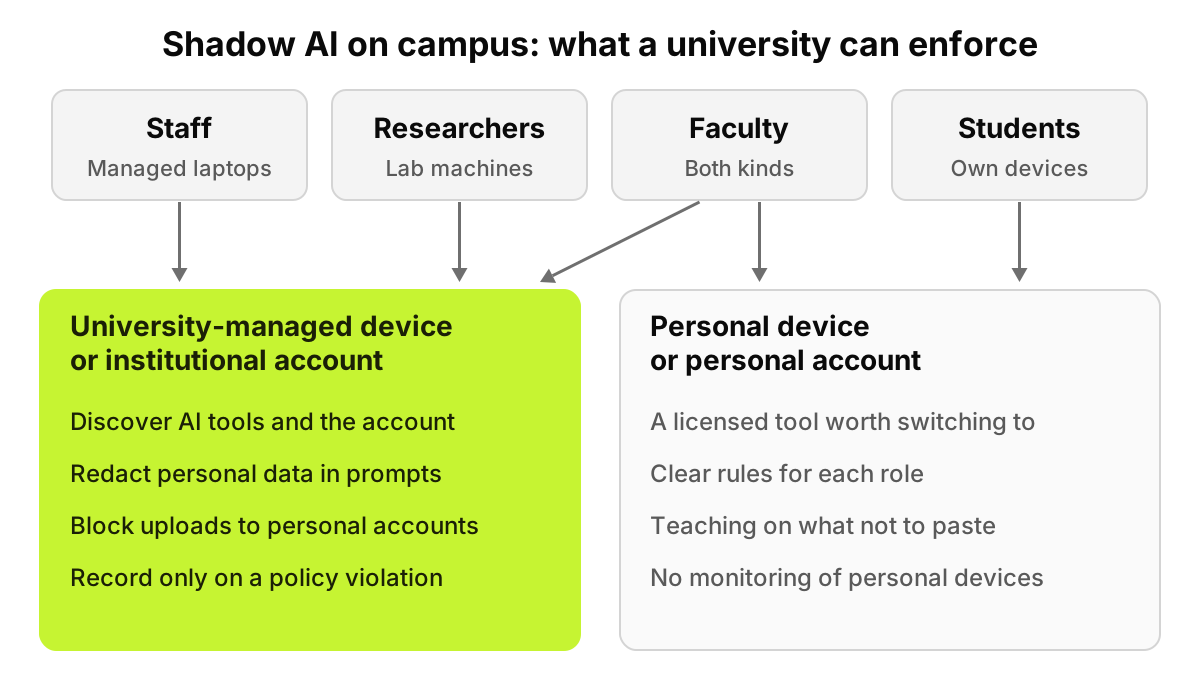
Four campus populations mapped to two zones: staff on managed laptops and researchers on lab machines point to university-managed devices and institutional accounts, where software can discover AI tools, redact personal data, block uploads to personal accounts and record only on violation; students on their own devices point to personal devices and accounts, where a licensed tool, role rules and teaching do the work; faculty point to both.
Figure 1. What a university can enforce depends on the device and the account, not the person.

Why is shadow AI on campus different from shadow AI in a company?

In a company, nearly everyone is an employee on a company laptop under one acceptable use policy. A university has at least four populations, and each one sits under different rules:

  • Students are the subjects of education records. Most use their own phones and laptops, and their use of AI for coursework is a teaching question before it is a security one.
  • Faculty hold grades, advising notes and exam content. Academic freedom makes a blanket tool ban hard to defend.
  • Staff in the registrar, financial aid, admissions and HR offices handle the densest personal data on campus, usually on machines the university manages.
  • Researchers hold unpublished findings and data received under agreements with sponsors and data providers, often on lab machines a department administers, not central IT.

Then add the structure. Colleges often run their own IT, labs buy hardware on grants, and research computing is a separate shop. A free AI tier leaves no purchase record at all.

Personal accounts sit next to institutional licenses. Google says Gemini for Education is included in all Google Workspace for Education editions free of charge, and that the data "is not human-reviewed or used to train AI models." Microsoft's Copilot Chat privacy page says prompts and responses aren't used to train the underlying foundation models, and that its enterprise data protection commitments apply with Microsoft acting as a data processor (the product was formerly Microsoft 365 Copilot Chat). Those commitments describe the institutional offerings. The same advisor can open the same product in the next tab under a personal account, on whatever terms that account carries, and the two look alike unless you can see which account is signed in.

Academic freedom and personal devices set the limits of what IT can do. Plan around them from the start.

What does FERPA say about student records and AI tools?

FERPA's regulations sit at 34 CFR Part 99. Section 99.1(d) says that when an institution receives funds under a covered program, the rules apply to the recipient as a whole, "including each of its components (such as a department within a university)". For a decentralized campus, that sentence matters: a department that picks its own AI tool is still inside FERPA.

What counts as an education record?

Section 99.3 defines education records as records "directly related to a student" and "maintained by an educational agency or institution or by a party acting for the agency or institution." The Department's Protecting Student Privacy FAQ lists grades, transcripts, class lists, course schedules, student discipline files and, at the postsecondary level, student financial information, recorded in any way, email included.

Personally identifiable information is broader than a name. The definition lists "a personal identifier, such as the student's social security number, student number, or biometric record", indirect identifiers such as date of birth, and any information that, alone or in combination, would let a reasonable person in the school community identify the student "with reasonable certainty." Deleting the name from an advising note does not by itself make it anonymous; a small program or a distinctive grade dispute can be enough.

Exclusions include sole-possession memory aids, most records about employees as employees (student employees aside), and certain treatment records.

When may an outside provider receive education records?

Generally only with consent, unless an exception in section 99.31 applies. "Disclosure" in section 99.3 covers access, release or transfer "by any means, including oral, written, or electronic means", so the question for each AI tool is which exception, if any, covers the transfer.

For vendors, the usual answer is the school official exception. Under section 99.31(a)(1)(i)(B), a contractor or other party to whom the institution has outsourced a service may be treated as a school official if it performs a function the institution would otherwise use employees for, is "under the direct control of the agency or institution with respect to the use and maintenance of education records", and is subject to section 99.33(a). That section lets the recipient use the information "only for the purposes for which the disclosure was made" and bars redisclosure without consent. The institution must also have determined that the official has a legitimate educational interest, and under section 99.7(a)(3)(iii) its annual FERPA notice must set out the criteria for both.

How is direct control established in practice? The Department's 2014 guidance, Protecting Student Privacy While Using Online Educational Services, says the regulations do not require a written agreement, but direct control is usually established through a contract signed by both sides, and sometimes terms of service suffice. It treats clicking "accept" as entering a contract, warns about terms the provider can amend without notice, and says staff should not bypass internal approval for free services. It was written for schools and districts before generative AI, but the reasoning fits chatbots.

Why is a personal AI account a risk to assess?

Take an example. Rachel Torres, an academic advisor, pastes a student's advising history into her personal chatbot account to draft a probation letter. The university signed nothing with that provider, has not named it as a school official in its annual notice, and has no control over how the provider uses or keeps what she typed. The account's terms were accepted by Rachel as an individual, and they may let the provider use content in ways the university never authorized.

Set that against the conditions above and it is hard to see which one the transfer meets. That is not a ruling, since facts matter, but it is the kind of disclosure to assess with your FERPA compliance officer and counsel. It is also the best argument for giving Rachel a licensed tool. A license can fit the exception if the contract supplies the direct control and use limits the regulation asks for; whether yours does is a reading of your contract, not the product page.

Which other rules apply on campus?

Two, briefly. The 2019 FERPA and HIPAA joint guidance from the Department and HHS says records at a university-affiliated hospital are not typically education records, and assuming the hospital is a HIPAA covered entity, they are subject to the HIPAA Rules. Records a campus clinic keeps on students are education records or treatment records under FERPA, and outside HIPAA. A university with a medical center can have both regimes in play at once.

Research data often comes with its own terms. A May 2025 National Cancer Institute reminder on NIH controlled-access genomic data says approved users may not share that data with public generative AI tools through prompts, and treats doing so as a breach of the non-transferability provision of the Data Use Certification. Other data use agreements will say different things, so read each one.

This is not legal advice; how FERPA, HIPAA or a data use agreement applies to a given tool is a question for your counsel and compliance office.
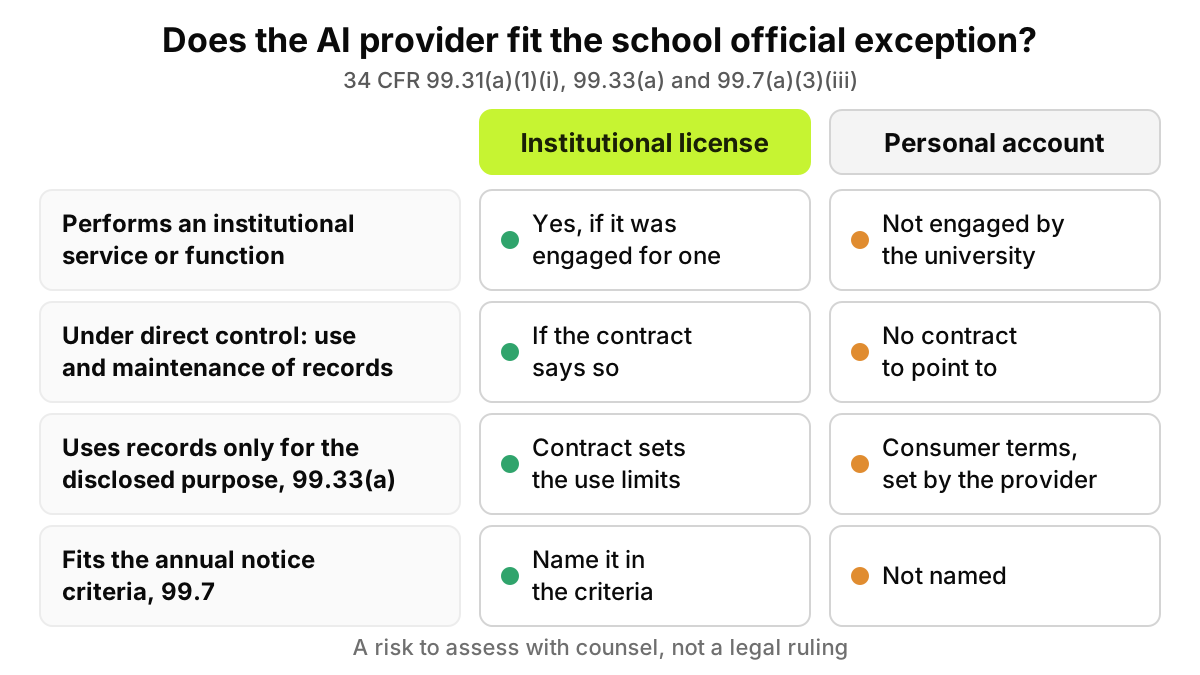
The school official test under 34 CFR 99.31(a)(1)(i) and 99.33(a), checked for an institutional AI license and a staff member's personal account: institutional function, direct control over use and maintenance, use only for the disclosed purpose, and named under the annual notice criteria. The license can meet each if the contract says so; the personal account has no contract to point to.
Figure 2. The test turns on the institution's agreement with the provider, so the account matters more than the product name.

Which campus data leaks through AI, and what governs it?

The pattern behind most of these rows is the same: someone wants a summary, a draft or a rewrite, and pasting is faster than asking.

Data typeWhere it leaks through AI on campusRule or agreement that usually governs itPractical control
Student education recordsAdvising notes, grade appeals and conduct files pasted into a personal chatbot to draft a letterFERPA, 34 CFR Part 99Licensed tool under contract; block personal-account uploads on managed devices; redact personal data
Financial aid dataAid files and family income details summarized in a free toolFERPA (the Department lists student financial information at the postsecondary level), plus your aid program agreementsAid office on licensed tools only
Unpublished research and IPDraft papers, grant proposals and invention notes pasted for editingUniversity IP policy and sponsor agreementsApproved tool for researchers; guidance on what counts as unpublished
Research data under a data use agreementDatasets uploaded for analysis; coding agents reading data foldersThe agreement itself; for NIH controlled-access genomic data, the Data Use CertificationRead each agreement for AI terms; inventory agents and MCP servers
Patient data in an academic medical centerClinical notes summarized by residents or researchers in consumer toolsHIPAA, where the hospital is a covered entityThe medical center's approved tools; block personal-account uploads
HR and staff recordsPerformance reviews, hiring notes and complaints drafted with AIHR policy and employment law; most employee records sit outside FERPA, student employees asideHR on licensed tools; same block on personal accounts
Exam and assessment contentQuestion banks uploaded to generate variants or answer keysAcademic integrity policy and test-bank license termsFaculty guidance; keep banks out of personal accounts

Almost every control in the last column depends on two things: a licensed tool people actually like, and the ability to tell an institutional account from a personal one on university devices.

What should a university do this term?

  1. Pick and announce the licensed tools. Name them, say who gets which, and explain how to sign in with the university identity. A ban without an alternative sends people to personal accounts.
  2. Classify data and say plainly what may go where. One page, one table, no legal phrasing.
  3. Give role-based guidance. Students, staff, faculty and researchers need different rules. Our AI acceptable use policy template is a fast starting point here, because its data-class permission matrix can be split by campus role instead of written four times.
  4. Enforce on university-managed devices and institutional accounts. That is where the institution has standing and the most sensitive data sits.
  5. Cover lab and research machines, including coding agents and MCP servers. An agent with shell access can read the data folder an agreement protects; our post on scoring MCP server risk shows how to rate each server.
  6. Include research computing platforms. Clusters, notebooks and research cloud accounts belong in the inventory.
  7. Record conversations only on violation. Capture prompt content only when a policy is broken, which respects faculty and student privacy and keeps the evidence that matters.
  8. Review each term. Put it on the academic calendar so it happens.

The order matters. Steps one to three make step four fair; a campus that blocks first and licenses later spends the semester on exceptions.

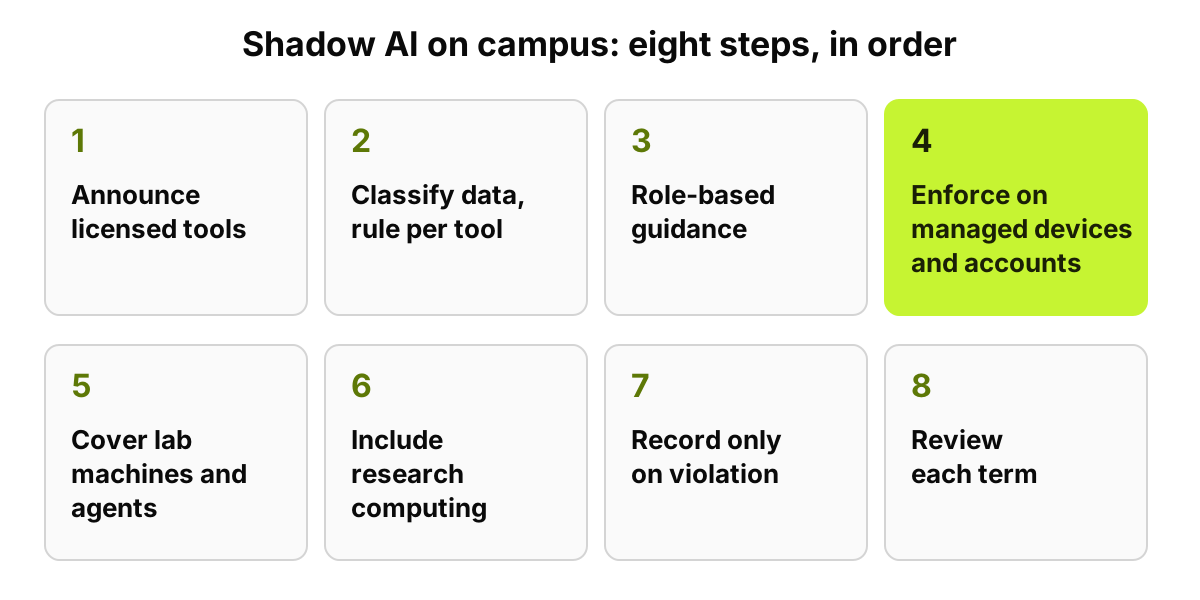
Eight-step campus sequence for shadow AI: announce licensed tools, classify data, give role-based guidance, enforce on managed devices and institutional accounts, cover lab machines and agents, include research computing, record only on violation, and review each term.
Figure 3. Enforcement is step four on purpose: a block is fair once people have a sanctioned tool and clear rules.

What can software do on campus, and what can't it?

Start with the limit. A university can't, and generally shouldn't, monitor students' personal phones and laptops, and no product changes that. For students, policy, licensing and teaching carry the load: a good licensed tool, clear course rules, and teaching on what not to paste.

Software helps where the institution has standing: university-managed devices and institutional accounts, which is also where most work with sensitive records happens. No tool decides your risk appetite, and no tool makes a university FERPA compliant.

Within that scope, AccuroAI recognizes 1,400+ AI tools in the browser and on managed devices, each with the signed-in account (personal or business) and the plan, so the licensed tool and a personal subscription show up as different things. Policies allow, redact or block per app, account type and data type: uploads to personal accounts can be blocked while the licensed tool keeps working, and national ID numbers, card numbers, email addresses and other personal data can be redacted where AI is allowed. Conversations are recorded only when a policy is violated. See our higher education page, the endpoint AI governance page for agents on lab machines, and the shadow AI hub for the wider picture.

FAQ

Does FERPA ban staff from using ChatGPT or other AI tools?

FERPA does not name AI tools. It limits disclosure of personally identifiable information from education records without consent, with exceptions such as the school official exception. The risk sits in what goes into the tool and under which account, so assess personal accounts and licensed tools separately with your compliance office.

Is a licensed university AI tool automatically FERPA-safe?

No. A license can support the school official exception if the agreement gives the institution direct control over use and maintenance of records and limits use to the disclosed purpose. Read the contract and terms, not the marketing page, and check that the provider fits the criteria in your annual FERPA notice.

Is removing a student's name enough to paste a record into AI?

Often not. FERPA's definition of personally identifiable information covers indirect identifiers and information that, alone or in combination, lets a reasonable person in the school community identify the student with reasonable certainty. A small program or distinctive case can identify someone without a name.

Should a university monitor students' personal devices for AI use?

Generally no, and students would rightly object. Enforcement belongs on university-managed devices and institutional accounts. For students on their own devices, the levers are a good licensed tool, course-level rules from faculty, and teaching on what not to paste.

Do research data use agreements restrict AI tools?

Many do, and the terms differ by agreement. For NIH controlled-access genomic data, a National Cancer Institute reminder says approved users may not share it with public generative AI tools through prompts. Read each agreement for AI, sharing and transfer terms before a lab adopts a tool.

See it on your own devices: a 72-hour pilot maps the AI already in use before any policy is enforced, starting with one department's managed machines. Start a free pilot.

Sources

More from the blog
See AccuroAI in action.

Book a 30-minute demo and see how security teams use AccuroAI to discover, govern, and protect every AI asset across their organization.

Book a demoStart a free pilot

15 enterprises secured · under 38ms p99 · Deployed in under 30 minutes · 72-hour pilot