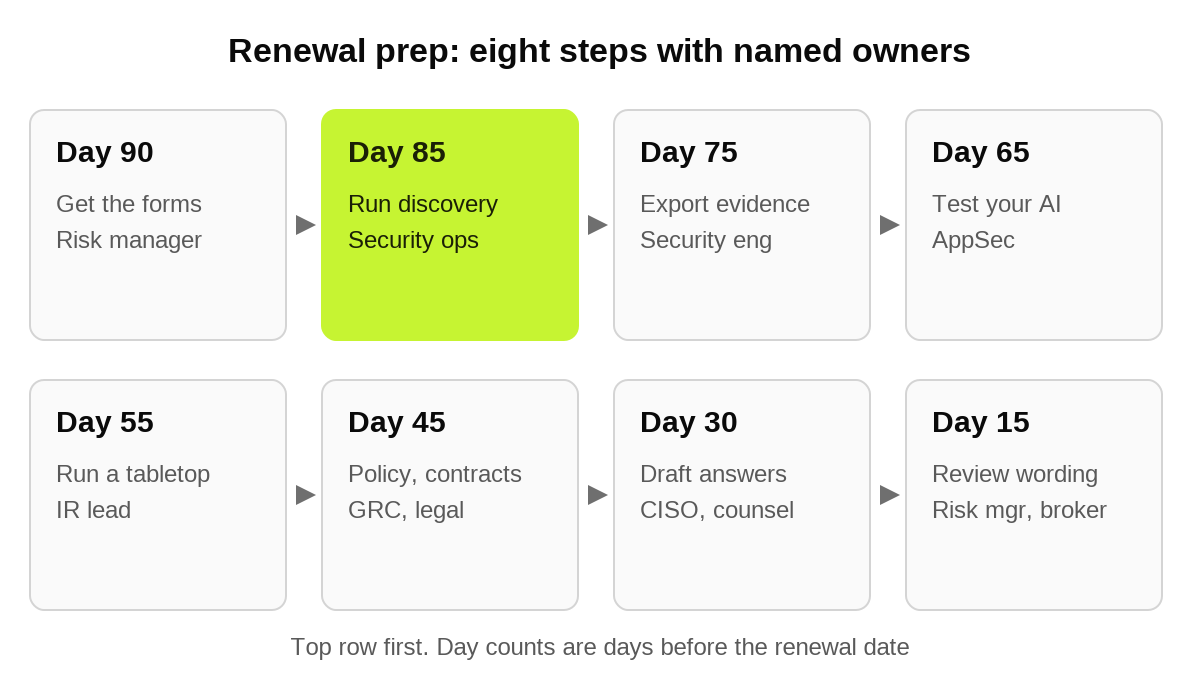
By late 2026, AI exclusions keep appearing in commercial policies, affirmative AI cover is arriving inside cyber and tech E&O wordings, and underwriters want evidence rather than attestations. For a first-quarter 2027 renewal, have three things ready: a dated AI inventory with account types, records showing your data and agent controls work, and test results.
Our August post covered how the AI exclusions arrived: the standard forms, the early filings and the first survey of underwriters. This one picks up from there. It covers what changed between August and November, why a vendor's AI certificate does not answer questions about your own use, and the evidence pack to build before the broker calls.
If you want a quick read on where your program stands first, the AI governance maturity assessment scores it against the same areas an AI supplement asks about, so you can see which answers will be thin before an underwriter does.
Last verified: 23 November 2026, against Aon's AI Fact Sheet 2026, Beazley's and CFC's own announcements, Marsh's published position on AI exclusions, the AIUC-1 site and changelog, and the NAIC's artificial intelligence topic page. Remarks by Marsh's chief executive come from a Reuters report carried by Insurance Journal and are marked as reported. Verisk's newsroom did not render for us, so this post reports no new ISO AI form after the January 2026 endorsements.
What has changed since August 2026?
Four things, each checked at its source.
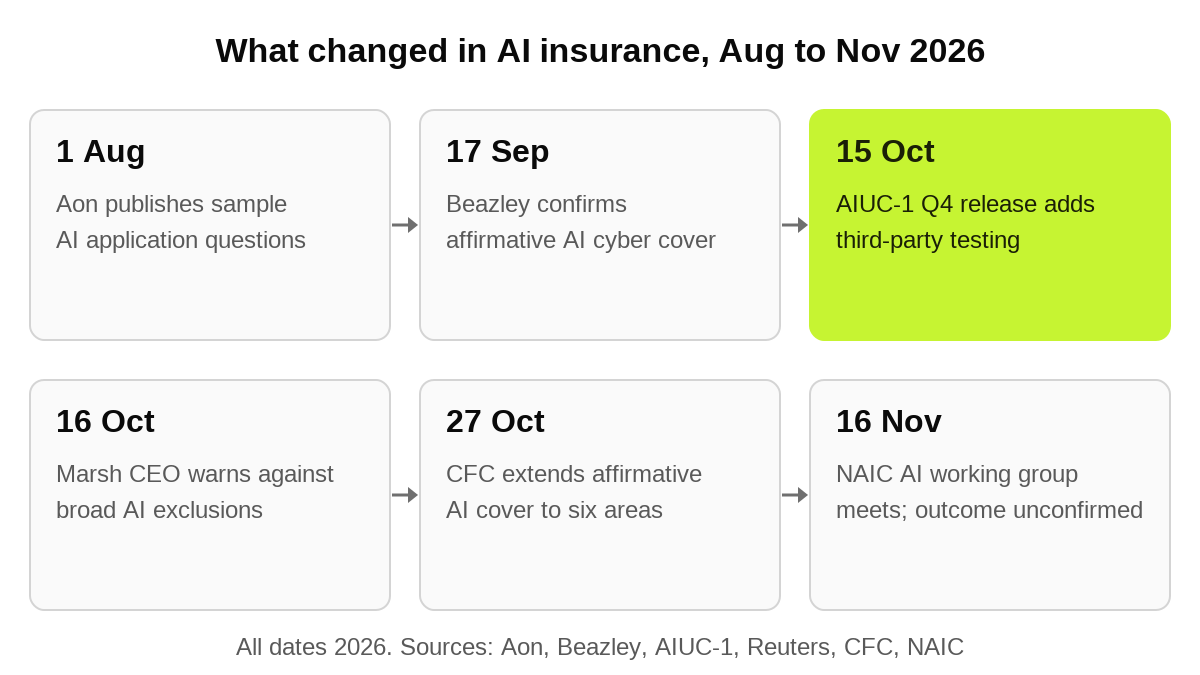
Carriers wrote down the questions. Aon's AI Fact Sheet 2026, published as of 1 August 2026, says carriers "are developing AI insurance application questions" and prints a representative sample. Several go straight at the insured's own operations. One asks whether you have an AI governance framework with board or management oversight that includes specific use cases, restrictions and authorization policies. Another asks, "Does a human need to verify accuracy before AI takes action?" A third asks, "Are AI actions logged so potential errors can be reviewed and remediated?" Others cover whether key vendors use AI and what pre-contract diligence you ran, whether your AI use is internal only or sold to customers, and who owns prompts and outputs under your contracts. Aon's footnote to the list describes evaluation artifacts as becoming the common language across underwriting, procurement and oversight.
Affirmative cover kept spreading, through existing policies. On 17 September 2026, Beazley confirmed affirmative AI cover in its cyber and tech E&O policies, wording that expressly addresses AI-related risks already covered in its cyber cover. It is offered on an admitted basis in some US jurisdictions and on a surplus lines basis, including through Beazley-managed syndicates at Lloyd's. On 27 October 2026, CFC extended its affirmative AI program to its eHealth and Professions products and said it now gives affirmative AI cover across six areas: media, intellectual property, financial services, cyber, healthcare and professional services. Neither announcement lists underwriting conditions. Both say the policy terms govern.
A major broker pushed back on broad exclusions. Marsh's published position, on a cyber risk page dated only by its 2026 copyright, is direct: "We cannot support broad or absolute AI, or generative AI, exclusions that create protection gaps for our clients." On a post-earnings call reported by Reuters on 16 October 2026, Marsh chief executive John Doyle said a broad-based AI exclusion could create "real confusion and uncertainty." The same Marsh page tells clients to build an inventory of AI use cases, agents, models, data and connections to business systems, and to turn governance into evidence they can defend.
The certification bar for AI vendors went up. AIUC-1, the AI agent standard maintained by the Artificial Intelligence Underwriting Company, released its Q4-2026 version on 15 October 2026. It added five requirements, including third-party testing for data and privacy risk (A009) and for accountability risk (E018), each backed by a third-party evaluation report. It folded hallucination testing into a broader reliability test, and it made human approval for sensitive tool operations (D003.4) a core control rather than a supplement.
One regulator item, with a caveat. The NAIC's work on AI concerns insurers' own use of AI in pricing, claims and underwriting, not what applicants must show. Its topic page said the AI Systems Evaluation Tool, piloted by 12 states as of March 2026, was expected to be adopted at the 2026 Fall National Meeting, and it listed a Big Data and Artificial Intelligence Working Group session for 16 November. We could not confirm the outcome as of 23 November 2026.
Does a vendor's AI certification cover how your company uses AI?
No, and this is where many renewal answers go wrong.
AIUC-1 is written for companies that build agents. Its own site says "Certify the AI agents built by your organization," and its scoping step defines "which agent or system is being certified, the deployment context, and the relevant control domains." The certificate is valid for a year, with quarterly retests against the version you were scoped to, and an accredited auditor reviews controls across six domains. That is meaningful evidence about one vendor's agent. It says nothing about which employees paste customer data into a personal chatbot account, which coding agents run on your laptops, or what your own customer-service bot is allowed to do.
The Aon sample shows the same split. Vendor questions sit beside questions about the insured: your framework, your human checks, your logs. Underwriters treat a vendor's certificate as an input to your vendor diligence, not as your answer.
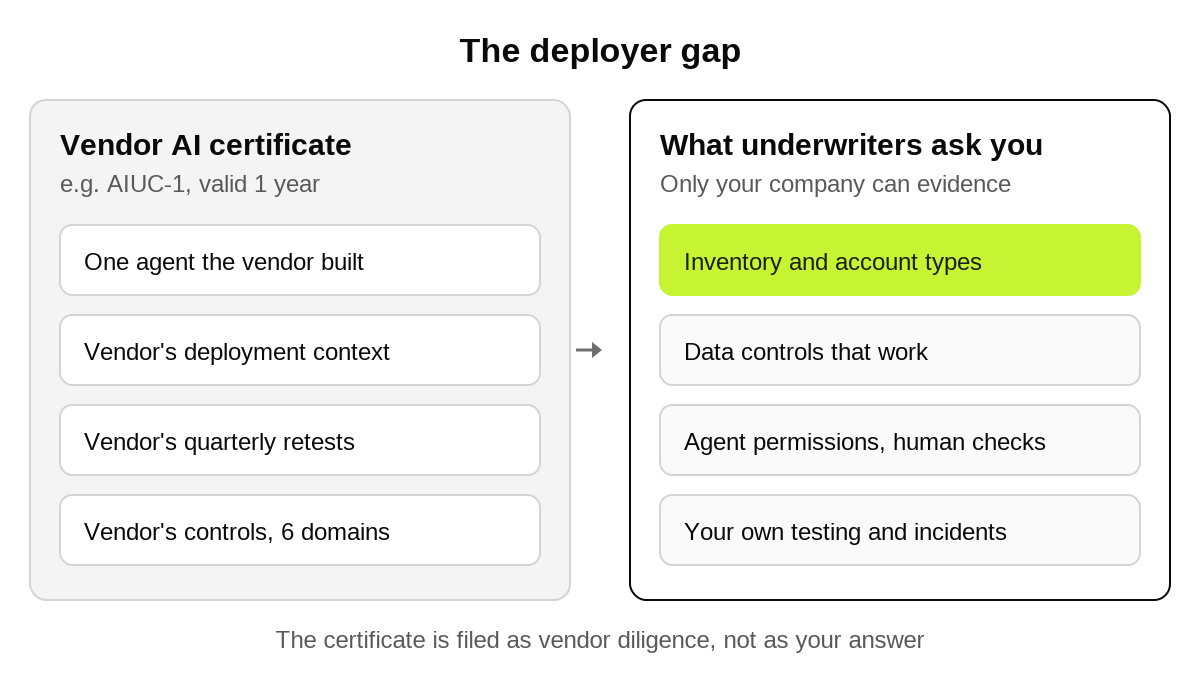
Think of the deployer gap in four parts. Inventory: which AI tools and agents are in use, under which accounts. Controls: what stops sensitive data or a risky action. Testing: whether anyone has attacked your own AI apps and agents. Incidents: what happened, what you did, and whether you would know next time.
Which questions do underwriters ask, and what evidence answers them?
The table below turns those question areas into evidence. The left column follows the themes in Aon's sample and Marsh's guidance. The middle and right columns are our recommendation for a credible answer, not any carrier's requirement.
| What the underwriter asks about | Evidence that answers it | Where it usually lives |
|---|---|---|
| Inventory of AI tools and agents | Dated export: tool, user count, first seen, owner, sanctioned or not | Discovery tooling, SSO logs, endpoint management |
| Personal vs business accounts | Share of AI use on licensed business accounts, and what happens to personal accounts | Browser or endpoint telemetry; identity provider |
| Data controls | Redaction and block events by data type, with a sample of real events | AI data protection logs, forwarded to the SIEM |
| Agent permissions and human checks | List of agents with their tools and scopes; which actions need a person to confirm | Agent registry, MCP allowlist, change tickets |
| Logging of AI actions | Retention policy plus an example trace: who, which tool, which data, which outcome | SIEM, application logs |
| Testing and red teaming | Dated test report on your own apps and agents, with findings and fixes | AppSec or red-team reports |
| Incident response | An AI scenario in the playbook, plus a tabletop record with actions | IR runbook, GRC tool |
| Governance and policy | Approved AI use policy with a date, named owner and use-case register | Policy library, committee minutes |
| Vendor contracts | Clauses on data use, prompts and outputs, liability and insurance; diligence record | Procurement, legal, vendor risk files |
Two rows trip people up. The inventory is often an approved-apps list, which misses personal accounts, desktop apps and coding agents; our comparison of shadow AI discovery methods shows which sources see which slice. And incident response is often a sentence in the policy rather than a dated exercise. The AI incident tabletop kit gives you three scenarios to run this quarter, which produces the record an underwriter can read.