Zero-Click AI Attacks: EchoLeak, ForcedLeak and the Image-URL Exfiltration Pattern
A zero-click prompt injection plants instructions in content an AI assistant reads later, then leaks private data through a URL the client loads by itself, usually an image. EchoLeak in Microsoft 365 Copilot (CVE-2025-32711) and ForcedLeak in Salesforce Agentforce followed that pattern, and both vendors fixed them on their side. This post maps each attack stage to the control that breaks it and gives a ten-step checklist for teams building their own RAG assistants and agents.
D
Dr. Marcus Chen
Threat Intelligence Director
Nov 22, 2026
On this page
A zero-click prompt injection is an attack in which the victim never clicks anything. The attacker plants instructions in content an AI assistant will read later, such as an email or a web form. When a user asks an ordinary question, the assistant follows them and writes private data into a URL the client loads by itself.
Usually that URL belongs to an image.
Two 2025 cases made this concrete. EchoLeak, tracked as CVE-2025-32711, hit Microsoft 365 Copilot through a single email. ForcedLeak hit Salesforce Agentforce through a public lead form and an allowlisted domain whose registration had lapsed. Microsoft and Salesforce fixed their products on their side. Neither fix reaches the RAG assistants and agents your own teams build, where the same three conditions are easy to recreate.
Last verified: 23 November 2026, against the NVD and Microsoft records for CVE-2025-32711, Salesforce's help article on Trusted URL enforcement, and OWASP's pages. The EchoLeak chain comes from an arXiv case study and the ForcedLeak details from The Register; both are secondary and attributed.
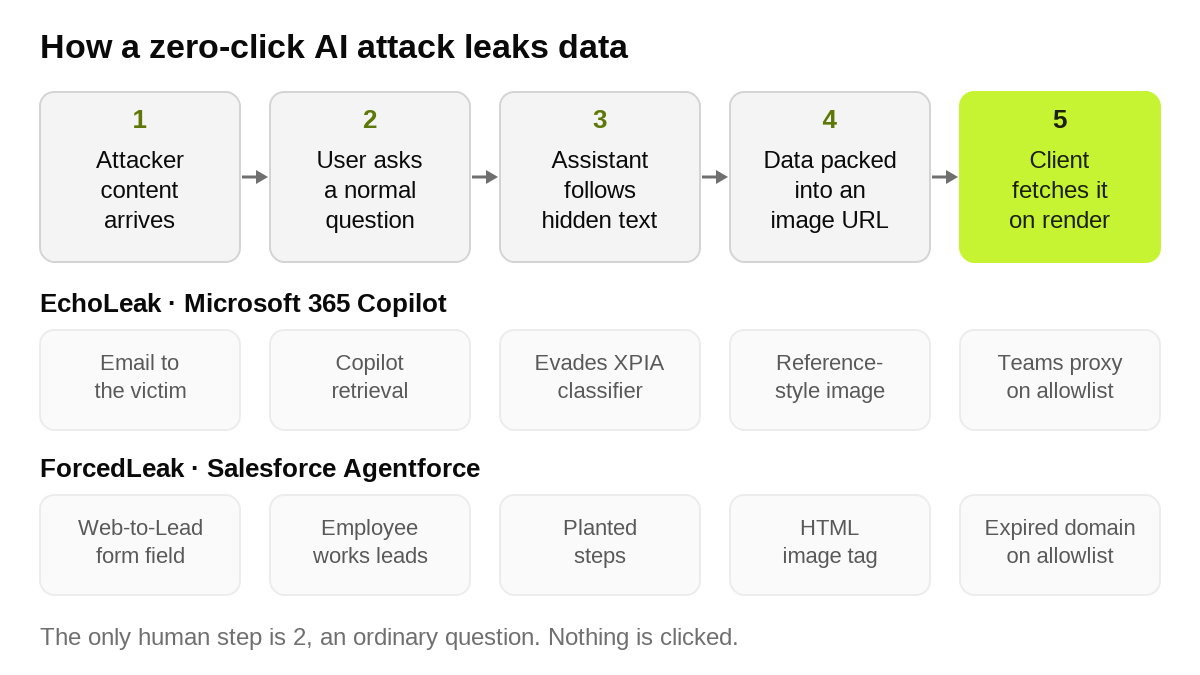
Figure 1. The only step a person performs is asking a question; the leak happens when the answer renders.
What makes an AI attack "zero-click"?
In phone security, zero-click means the target does nothing. With AI assistants it is narrower: the victim does ask a question, as they do every day, but never opens the attacker's attachment, follows a link or approves anything unusual.
Emily Carter, a finance analyst in a hypothetical, asks her company's assistant to summarize this week's supplier emails. One, from outside, carries text addressed to the assistant. It tells the assistant to gather the quarter's figures and add an image to its reply, with the figures packed into the image address. Her chat window fetches the image to display it, and the request, query string and all, lands in the attacker's server log. Emily sees a normal summary and maybe a broken image icon.
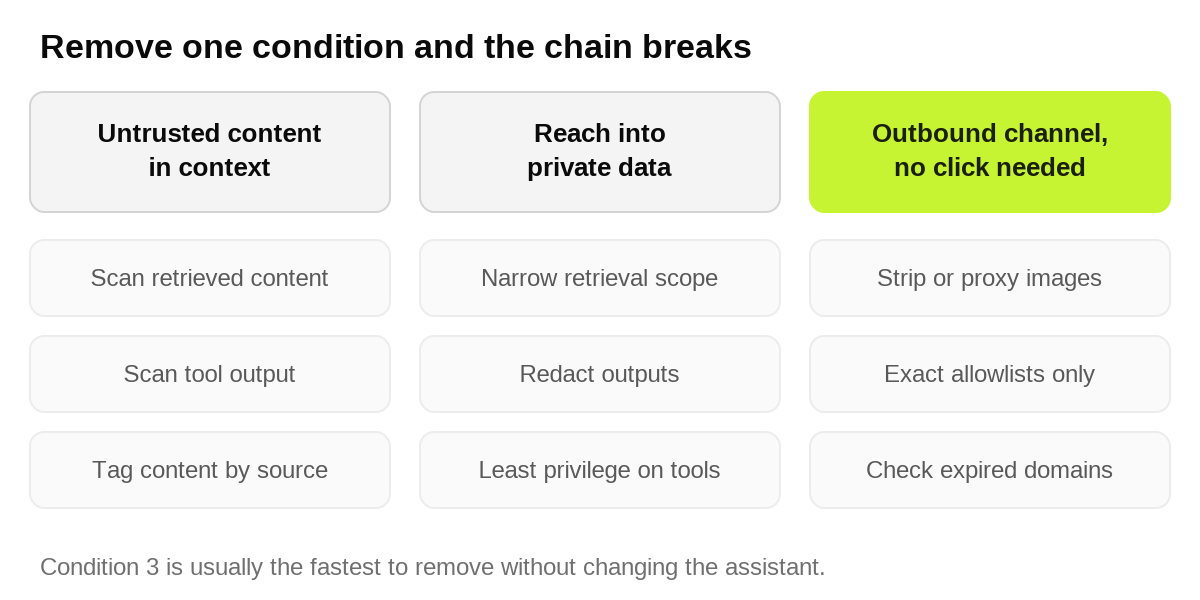
Three things had to be true at once:
Untrusted content reached the model's context.
The assistant could reach private data in the same turn.
Something outside was contacted without a click: a rendered image, a link preview, an allowlisted proxy or a tool call.
This is indirect prompt injection, instructions arriving inside data, combined with an egress channel that fires on render. The OWASP entry for LLM01:2025 Prompt Injection includes the image version as an example scenario: hidden instructions on a web page make the model insert an image linking to a URL, leaking the private conversation.
What happened in EchoLeak (CVE-2025-32711)?
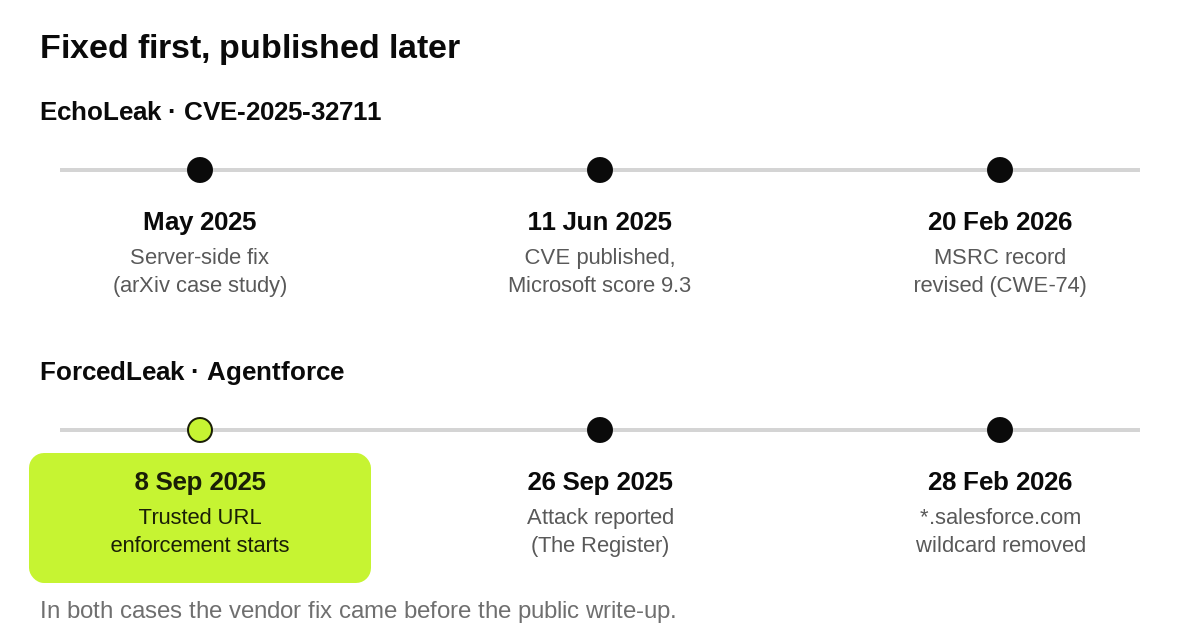
Microsoft published CVE-2025-32711 on 11 June 2025 as "M365 Copilot Information Disclosure Vulnerability". The NVD record describes it as AI command injection in M365 Copilot that lets an unauthorized attacker disclose information over a network. Microsoft, as the CNA, scored it 9.3 (Critical) under CVSS 3.1 with no privileges and no user interaction required. NVD's own assessment is 7.5 (High). The weakness is CWE-74, a value Microsoft updated in a 20 February 2026 revision.
The Microsoft Security Update Guide entry marks the flaw as not exploited and requires no customer action. Its FAQ says the issue was "fully mitigated by Microsoft" and that the CVE was published for transparency.
Neither record describes the chain. The clearest independent account is a September 2025 case study on arXiv by Pavan Reddy and Aditya Sanjay Gujral of The George Washington University, analyzing a disclosure by security researchers. According to it, an external email carried instructions worded to slip past Microsoft's cross-prompt injection (XPIA) classifier, and told Copilot not to mention the email. Copilot pulled it in through normal retrieval when the user later asked for related information. The instructions had Copilot put sensitive context into an attacker URL. Copilot's redaction removed inline markdown links but missed reference-style ones, and a reference-style image made the client fetch the address automatically. The content security policy blocked unknown domains, so the request went through an allowlisted Microsoft Teams endpoint that fetched the attacker's URL on the client's behalf.
The paper dates Microsoft's server-side fix to May 2025, before the June advisory, and reports no evidence of exploitation in the wild.
Copilot had an injection classifier, link redaction and a content security policy. Each layer had one gap. Lined up, the gaps formed a path.
What happened in ForcedLeak?
In a help article first published on 8 September 2025, Salesforce announced that from that date it would enforce Trusted URL allowlists for Agentforce and Einstein Generative AI agents. Agents may only produce links to approved domains; a link to a domain that is not on the org's Trusted URL list or in the agent's instructions is blocked. Salesforce's stated reason is to keep malicious links from being called or generated through potential prompt injection, and to stop sensitive data escaping through external requests after a successful injection.
An update on 13 February 2026 removed the *.salesforce.com wildcard from the default allowlist from 28 February 2026, to reduce prompt injection risk tied to broad wildcards. Admins are told to list the exact domains their agents need, pick a CSP directive per entry (img-src for images) and remember that any URL added "will be allowed throughout your entire Salesforce Org".
The attack itself is described in The Register's report of 26 September 2025. According to that report, security researchers used Salesforce's Web-to-Lead feature, which lets outside visitors submit leads. The name and company fields allowed roughly 40 to 80 characters, so they used the description field, which allows 42,000. When an employee later had Agentforce work through the leads, the agent followed the planted steps: list the lead email addresses and embed them in an HTML image tag pointing at an attacker-controlled server. That server's domain was still on Salesforce's content security policy allowlist but had expired. The researchers registered it for five dollars.
Salesforce re-secured the domain, The Register reported, and a spokesperson said its patches "prevent output in Agentforce agents from being sent to untrusted URLs" but declined to say whether the flaw had been exploited. No CVE was assigned. The 9.4 score that circulates is the researchers' own CVSS 4.0 rating.
Here the control and the hole were the same object. An allowlist is only as good as the ownership of every domain on it, and domains lapse quietly.
Figure 2. In both cases the vendor fix shipped before the public write-up, so customers learned of the flaw after it was closed.
What pattern do EchoLeak and ForcedLeak share?
Strip away the product names and the attacks share a shape. Untrusted text entered through a channel the business wants open: inbound email, a public lead form. The assistant read it while doing legitimate work for a legitimate user, with reach into private data. And the client fetched an image from an address the model wrote, through a domain the policy trusted.
You do not have to win at every stage. Remove any one condition and this chain breaks, which helps, because the first is the hardest to remove. Businesses need to read email.
Which control breaks each stage of the attack?
Attack stage
What the attacker does
Control that breaks it
Usually owned by
Delivery
Sends an email, submits a form or publishes a page the assistant will read
Tag external content by source; scan retrieved content and tool output for instructions before the model sees it
App team, runtime security layer
Retrieval
Words the payload so it matches what employees ask about
Narrow retrieval scope; keep public-form fields and external mail out of the index unless the use case needs them
AI platform owner, data owners
Instruction following
Tells the model to gather data and hide where the request came from
Instruction detection on retrieved text; prompts that separate content from commands; least privilege on tools and connectors
App team
Encoding
Has the model pack data into a query string, image tag or link
Redact personal data and secrets in outputs; flag responses containing URLs built from context
App team, runtime security layer
Egress
Relies on the client fetching an image or preview, or on a trusted domain
Strip or proxy external images and links; restrict img-src; review allowlist entries, including expired domains; show full link targets
Client or platform owner, web team
Detection
Counts on nobody reading the logs
Log agent, session, tool and outcome per request; alert on blocked and redacted events
Security operations
Both vendor fixes landed in the egress row, which is often owned outside security: by the front-end team that chose a markdown renderer, or the admin who added a domain years ago. Our piece on AI agent data exfiltration prevention separates rendered output from tool calls, because their controls sit in different places.
What should teams building RAG assistants and agents do now?
Run this list against each assistant or agent you own, starting with the one that has public inputs and the widest data reach.
The AI Agent Risk Exposure Calculator helps pick that first one: five inputs return an estimated annualized loss and your top OWASP Agentic exposures, so the testing order rests on a number.
Figure 3. The outbound channel is highlighted because it is the condition a team can usually remove fastest without changing what the assistant is for.
Map untrusted inputs. List every source of text a stranger can write: inbound mail, public forms, shared files, web fetches, tickets, tool results.
Scan what the model reads. Retrieved passages and tool output need the same injection checks as prompts.
Shrink data reach. A lead-triage agent rarely needs every lead's email address in one turn.
Decide how output renders. Block external images by default or proxy them without query strings. Show full link targets.
Audit every allowlist. Give every CSP, Trusted URL and egress entry an owner, confirm the domain is still yours, and replace wildcards with exact domains, as Salesforce did with its default.
Redact in outputs and tool inputs. Personal data and secrets should not leave in a reply or tool argument.
Confirm risky actions. Sending email or calling new domains should need a person when the request came from retrieved content.
Log each request with its context. Agent, session, tool and outcome, sent to your SIEM.
Red-team with indirect payloads. Plant instructions in a test email, form field and document; try reference-style markdown and image tags. Repeat after every model, prompt or connector change; our guide to red teaming AI agents covers cadence and triage.
Track vendor advisories for SaaS assistants. For Copilot and Agentforce the fix is the vendor's; your part is configuration and watching MSRC and Salesforce notices.
What can software catch, and what stays with the platform owner?
For the LLM apps and agents a company builds and routes through AccuroAI Runtime Security, every request is scanned for prompt injection and jailbreaks, including the retrieved content and tool output where EchoLeak-style instructions hide. Personal data and secrets are detected and redacted in inputs, outputs and tool inputs. Request logs show the agent, session, tool and outcome (blocked, redacted, flagged or clean), with alerts to email, Slack or Teams.
Before an app ships, AI Red Teaming (Beta) runs automated attacks, indirect injection among them, against your own models and agents. Findings map to the OWASP LLM and Agentic Top 10 and MITRE ATLAS, and each attack is replayed through AccuroAI runtime protection to show attack success with and without it.
Some of this is not ours to do. AccuroAI does not sit inside Microsoft 365 Copilot or Agentforce; Microsoft and Salesforce fixed those flaws in their own services, and their settings (Copilot permissions, the Trusted URL list) belong to your platform owners. How your chat client renders images and links, and what your content security policy allows, are front-end decisions. Injection detection is also probabilistic. EchoLeak got past a production classifier, and no scanner catches every phrasing, which is why the table has six rows instead of one.
FAQ
Is zero-click prompt injection the same as indirect prompt injection?
Not quite. Indirect prompt injection describes where the instructions come from: external content the model reads. Zero-click describes how the data leaves: through a channel that fires without the user clicking, such as an auto-loaded image. EchoLeak and ForcedLeak were both, which is what made them serious.
Do we need to do anything about EchoLeak today?
Microsoft's advisory requires no customer action and says the issue was fully mitigated by Microsoft. What remains worth doing is reviewing what Copilot can retrieve, since reach decides what any future injection could expose. Our post on Microsoft 365 Copilot permissions covers that.
Did ForcedLeak receive a CVE?
No. According to The Register, no CVE was assigned, and the 9.4 score in circulation is the researchers' own CVSS 4.0 rating. Salesforce's fix was Trusted URL enforcement for Agentforce and Einstein Generative AI agents, starting 8 September 2025, later tightened by removing the salesforce.com wildcard from the default.
Why are markdown images such a common exfiltration channel?
Because rendering an image means requesting it. Whatever the model writes into the image address, including a query string full of data, travels to that server the moment the reply appears. No click, no warning, and often nothing visible beyond a broken icon. Link previews and unfurls behave the same way.
Is a URL allowlist enough on its own?
No. Both cases went through trusted routes. ForcedLeak used a domain that was on the allowlist but had expired, and EchoLeak, according to the arXiv case study, used an allowlisted Microsoft Teams endpoint as a proxy. Keep allowlists exact and owned, and pair them with input scanning and output redaction.
The useful test is your own app with a planted email or form field in its context. Book a demo to see indirect-injection detection on retrieved content and tool output in one of your AI apps, or read how AI Agent Security protects the agents you build.