AI Governance for Insurers: What the NAIC Bulletin and NYDFS Expect in 2026
AI governance for insurers starts with a written AI systems program. The NAIC model bulletin, adopted December 4, 2023 and on NAIC's list for 29 jurisdictions as of November 3, 2026, expects governance, risk controls and third-party oversight, while NYDFS Circular Letter No. 7 adds fairness testing and vendor terms for underwriting and pricing. We read each regulator's own text, split the work between decision models and staff AI use, and set out a 90-day plan.
S
Sofia Reyes
Head of Compliance
Nov 11, 2026
On this page
AI governance for insurers starts with a written AI systems program. The NAIC model bulletin, adopted December 4, 2023 and now on NAIC's list for 29 jurisdictions, expects governance, risk controls and third-party oversight. New York's Circular Letter No. 7 adds fairness testing and vendor terms for underwriting and pricing. Staff AI use needs separate data controls.
Those are two problems with two sets of owners. One is the models that decide who gets a policy, at what price, and how a claim moves. The other is the adjuster who pastes a claim file into a chatbot. Regulators have written mostly about the first; cybersecurity rules already reach the second. Below, each instrument, a map to both halves, and a 90-day plan.
Last verified: 11 November 2026, against the NAIC model bulletin, Model Law #668, NAIC's AI page and adoption list (status 3 November 2026), NYDFS Circular Letter No. 7, the NYDFS October 2024 AI letter and cybersecurity page, the Colorado General Assembly's SB21-169 page and the Division of Insurance's August 2025 notice. The Division's website refused our requests, so its regulation is described from that notice and NAIC's list.
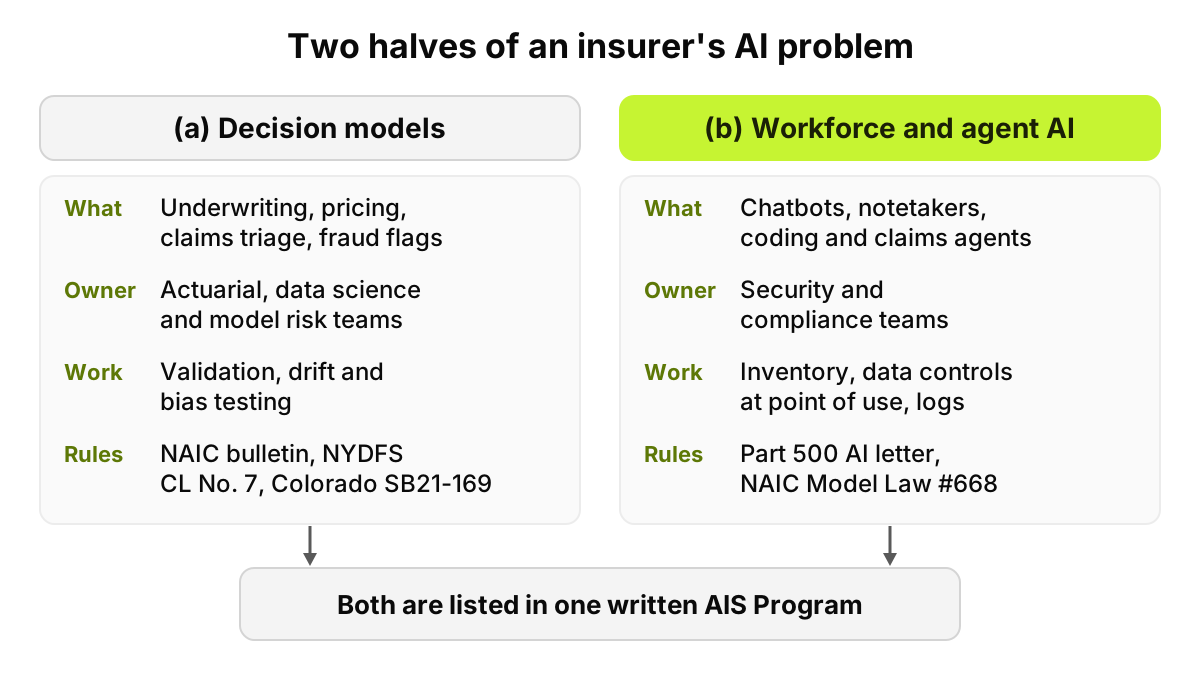
Figure 1. One program document, two sets of owners. Bias testing sits on the left; data controls on staff AI sit on the right.
What does the NAIC model bulletin expect from insurers?
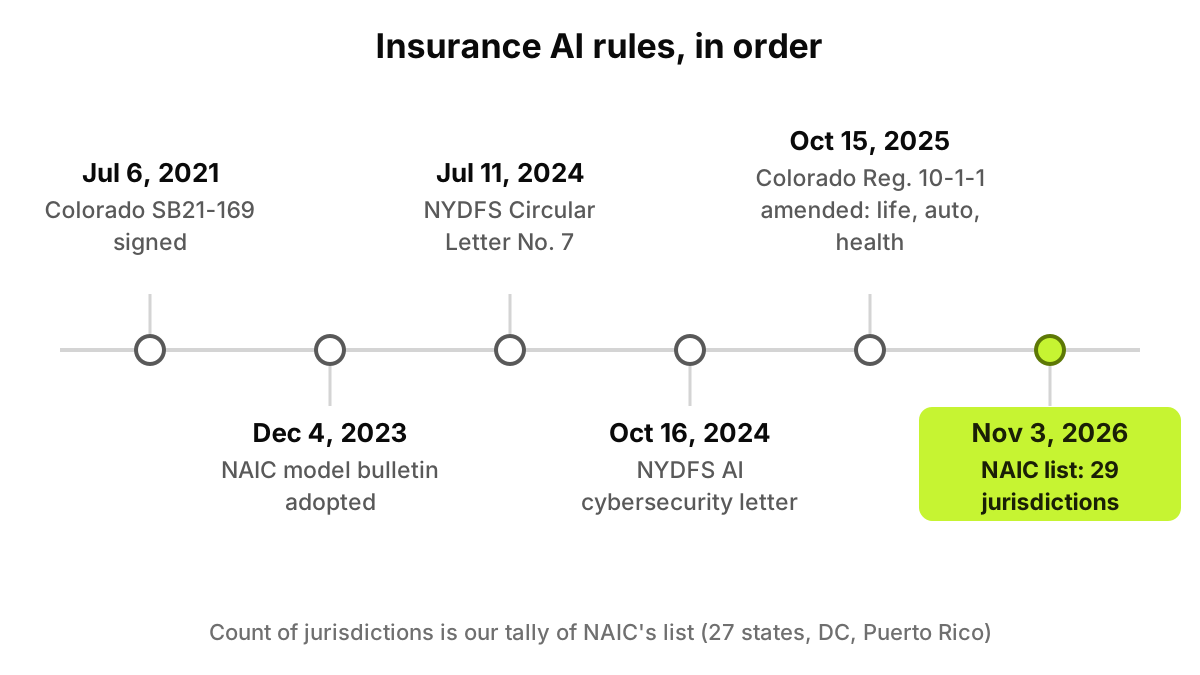
The NAIC Model Bulletin on the Use of Artificial Intelligence Systems by Insurers was adopted by the NAIC's Executive (EX) Committee and Plenary on December 4, 2023. It is a model, not a law. Each state insurance department decides whether to issue it, and may change its definitions.
NAIC keeps a reference list of adopting states. The copy we read, status as of November 3, 2026, names 29 jurisdictions under "Adopted States": 27 states, the District of Columbia and Puerto Rico (our count). California, Colorado, New York and Texas appear separately, with their own insurance-specific regulation or guidance. Check the status date before you cite a number.
The core expectation is one sentence. Insurers "are expected to develop, implement, and maintain a written program (an "AIS Program") for the responsible use of AI Systems that make, or support decisions related to regulated insurance practices." The guidelines that follow cover governance, risk management and internal controls, and third-party AI systems and data. Senior management, accountable to the board or a board committee, owns the program. It should be proportionate to the insurer's reliance on AI, and it may sit inside the enterprise risk program or draw on the NIST AI Risk Management Framework.
Two details set the scope. The program should cover AI "across the insurance life cycle," including underwriting, rating and pricing, claim administration and payment, and fraud detection. And the bulletin's AI System definition includes systems that generate "content (such as text, images, videos, or sounds)," so generative AI is inside it. Whether a given staff use supports a regulated decision is for counsel.
Section 4 covers examinations. Whatever the state of its written program, an insurer "can expect to be asked about its development, deployment, and use of AI Systems" in an investigation or market conduct action. A regulator may request the written program, evidence of its adoption, inventories of predictive models and AI systems, third-party diligence records, and any AI systems "not included in or addressed by the AIS Program." Read that last item twice. A program that leaves staff AI out will be asked why.
More is coming. NAIC's AI topic page describes an AI Systems Evaluation Tool for regulators, piloted by 12 states as of March 2026, and says "it is anticipated the Tool will be adopted at the 2026 Fall National Meeting," which NAIC lists for November 14 to 17, 2026, in Dallas.
What does NYDFS Circular Letter No. 7 add?
New York went deeper and narrower. Insurance Circular Letter No. 7, dated July 11, 2024, covers AI systems (AIS) and external consumer data and information sources (ECDIS) in underwriting and pricing. It "is not intended to address phases of the insurance product lifecycle other than underwriting and pricing," so claims sit outside it.
Inside that scope it is specific. Insurers "must be able to demonstrate that the ECDIS employed for underwriting and pricing are not prohibited," which means checking whether a data source acts as a proxy for a protected class. Discrimination testing "should be administered prior to putting AIS into production," and insurers are encouraged to use multiple statistical metrics. The board oversees; senior management implements; both answer for outcomes.
Vendors do not move the duty. "Insurers retain responsibility for understanding any tools, EDCIS, or AIS used in underwriting and pricing," and an insurer may not rely on the proprietary nature of a vendor's algorithm. Where appropriate, contracts should give audit rights or audit reports and require the vendor to cooperate with regulatory inquiries. The NAIC bulletin names the same two terms.
What does Colorado require under SB21-169?
Colorado legislated. SB21-169, "Restrict Insurers' Use Of External Consumer Data," was signed on July 6, 2021. It bars unfair discrimination on protected characteristics and, under the commissioner's rules, "using any external consumer data and information source, algorithm, or predictive model" that unfairly discriminates. The rules must require insurers to keep a risk management framework reasonably designed to detect it, with the chief risk officer attesting that it is in place.
The Division of Insurance implements this through Regulation 10-1-1. Its notice of August 20, 2025 says the commissioner adopted an amended version covering insurers that offer individual life insurance, private passenger automobile insurance and health benefit plans and use ECDIS, and that it "is effective on October 15, 2025." NAIC's list cites it as 3 CCR 702-10. We could not confirm the status of Colorado's quantitative testing rules as of 11 November 2026.
Figure 2. Every date is from the regulator's own document. The jurisdiction count is our tally of NAIC's list.
Where do cybersecurity rules meet the AI staff use every day?
Here the rules are older and reach further. New York's 23 NYCRR Part 500 covers organizations licensed under the Banking Law, the Insurance Law or the Financial Services Law. An industry letter of October 16, 2024 explains how Part 500 applies to AI and "does not impose any new requirements."
Three passages in it read like a brief for workforce AI controls. Entities "should identify all Information Systems that use or rely on AI," and as of November 1, 2025 the asset inventory must cover all information systems. Staff permitted to use AI-powered applications "should be trained" to draft queries that avoid disclosing nonpublic information (NPI). Entities that let personnel use tools such as ChatGPT should consider monitoring for unusual query behavior and "blocking queries from personnel that might expose NPI to a public AI product or system." Our financial services AI playbook covers the rest of the NYDFS picture.
Elsewhere, the NAIC Insurance Data Security Model Law (#668) applies only where a state has enacted it. Where it has, each licensee keeps a written information security program based on its risk assessment, trains staff on the risks it found, and oversees third-party service providers, defined as a person that contracts with a licensee and is permitted access to nonpublic information. An AI vendor under contract fits that definition. A personal chatbot account has no contract, so in our reading it is the disclosure the program exists to prevent, not a vendor to oversee. Nonpublic information under #668 includes an identifier combined with a Social Security or account number, and most health information: an ordinary claim file.
Which half of the AI problem does each team own?
Half (a) is decision models: underwriting scores, rating plans, claims triage, fraud flags. That is model risk management, covering data lineage, validation, drift and the testing Circular Letter No. 7 describes, run by actuarial, data science and model risk teams. No workforce security tool does that work, AccuroAI included.
Half (b) is everyday AI use by people and agents. A fictional adjuster, Emily Carter, pastes a claim summary with a policyholder's Social Security number into a personal ChatGPT account to draft a letter. Broker Adam Bailey signs up for an AI notetaker with his work email, so client calls land with a vendor nobody reviewed. Developer David Kim runs a coding agent beside a claims database while building a claims-automation agent. None of this is a pricing model. All of it moves NPI, and it calls for an inventory, data controls at the point of use, and logs. Our shadow IT versus shadow AI post explains why app approval rarely sees it.
The halves meet in the written program, whose inventory, scope and third-party sections are easier to answer when both are listed with owners.
How do the requirements map to each half?
Requirement or expectation
Source
(a) Decision models
(b) Workforce and agent AI
Written AIS Program: governance, risk management, internal controls
NAIC model bulletin, Section 3
Documents model governance and testing
States whether staff AI is in scope, and why
Senior management accountable to the board
NAIC bulletin guideline 1.3; NYDFS CL No. 7
Named model owners report up
Named owner for staff AI controls
Coverage across the life cycle, including claims and fraud
NAIC bulletin guideline 1.6
Claims triage and fraud models
Adjuster and claims-agent AI use
Inventories of models and AI systems; exclusions disclosed
NAIC bulletin guidelines 4.0 to 4.2; NYDFS CL No. 7
Model and data vendors contracted
AI tool vendors reviewed
Proxy and discrimination testing before production
NYDFS CL No. 7; Colorado SB21-169
Actuarial and model risk test and document
Not addressed by workforce controls
Risk management framework with CRO attestation
Colorado SB21-169; Regulation 10-1-1
Framework for ECDIS and models
Indirect: shows where data flows
Identify AI systems; train staff; consider blocking NPI to public AI
23 NYCRR Part 500, via NYDFS AI letter
Model systems in asset inventory
Training, monitoring, blocking at point of use
Written security program; service provider oversight
NAIC Model Law #668, where enacted
Model vendors as service providers
AI vendors with NPI access as service providers
What should an insurer do in the next 90 days?
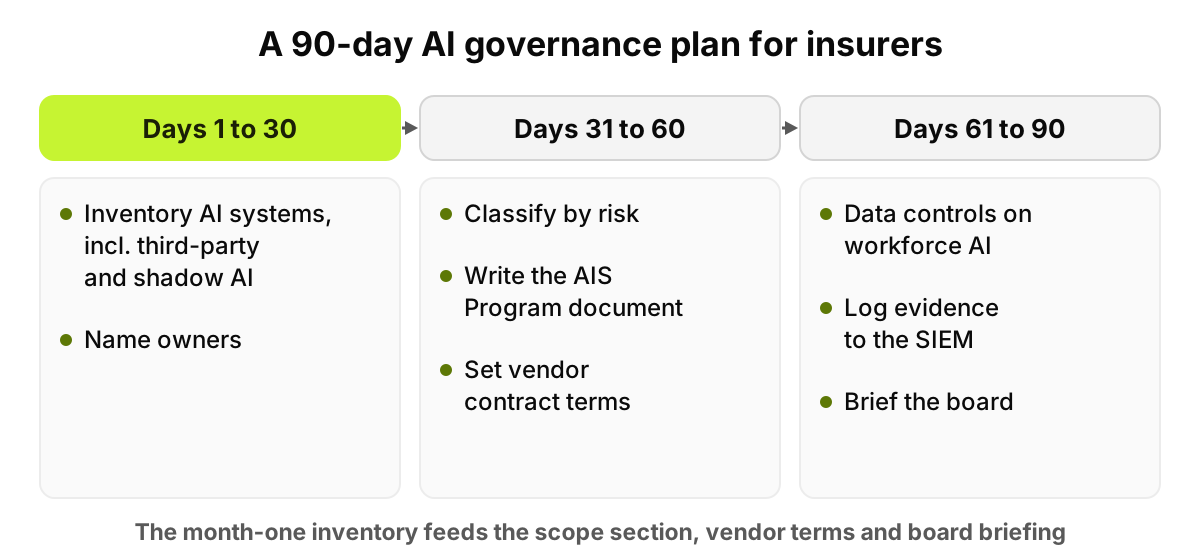
Inventory AI systems (weeks 1 to 3): decision models, third-party AI inside purchased systems, then shadow AI, with the account and plan behind each tool.
Name owners (weeks 2 to 4): one per model, one per vendor, one for staff AI.
Classify by risk (weeks 3 to 6) on the bulletin's factors: the decision, potential harm, human involvement, explainability, third-party reliance. Our AI risk assessment guide has a tiering method.
Write the AIS Program document (weeks 4 to 8), including what is out of scope and why.
Set vendor contract terms (weeks 5 to 9): audit rights, regulatory cooperation, data use.
Put data controls on workforce AI (weeks 6 to 10): approved business accounts, personal accounts blocked for NPI, prompts redacted.
Log evidence (weeks 8 to 11) into the SIEM, with a stated retention period.
Brief the board (week 12) on the inventory, owners, open risks and dates.
For step 5, the free AI vendor security questionnaire gives procurement 50 scored questions across 8 domains, a ready start on the third-party AI section of the program.
Figure 3. The inventory in the first month feeds every later step, from the scope section to the board briefing.
What can software do for an insurer, and what stays with people?
No product makes an insurer compliant with the bulletin, Circular Letter No. 7, Colorado's regulation, Part 500 or #668. The program, the testing, the contracts and board oversight are human work. Workforce tools have limits too: they see managed devices, not a broker's personal phone, and they cannot tell you whether a model is fair.
For half (b), AccuroAI does a narrower job. It recognizes 1,400+ AI tools in the browser and on managed devices, with the signed-in account (personal or business) and the plan, which fills the inventory's shadow AI rows. Inline redaction runs 40+ classifiers in under 38 ms p99, so a pasted Social Security number is removed before the model sees it. Uploads to personal accounts can be blocked while the licensed tool keeps working. Audit logs stream to SIEMs such as Splunk and Microsoft Sentinel. Our insurance page covers claim files, scanned records and claims agents.
FAQ
Is the NAIC AI model bulletin binding?
Not by itself. It is a model each state insurance department may issue, sometimes with changes. Where a state has issued it, insurers are expected to keep a written AIS Program. NAIC's reference list, status as of November 3, 2026, shows 27 states, the District of Columbia and Puerto Rico.
Does Circular Letter No. 7 apply to claims?
No. It is limited to underwriting and pricing and says it does not address other phases of the product lifecycle. Claims models can still fall under the NAIC bulletin where a state has issued it, because the bulletin covers claim administration, payment and fraud detection.
Does an adjuster's use of ChatGPT belong in the AIS Program?
The bulletin's AI System definition includes generated content, and examiners may ask about AI systems left out of the program. Whether a staff use supports a regulated decision is for counsel. Either way, Part 500 guidance and #668 reach the NPI staff put into AI tools.
Who should own bias testing of underwriting models?
Actuarial, data science and model risk teams, with compliance and legal reviewing. Circular Letter No. 7 expects testing before production and encourages multiple statistical metrics. Workforce AI security tools, AccuroAI included, do not test models for unfair discrimination.
Does the October 2024 NYDFS AI letter create new rules?
No. It says it imposes no new requirements beyond Part 500. It explains how existing duties apply to AI: identifying systems that use AI, training staff to keep NPI out of queries, and considering blocks on queries that might expose NPI to public AI.
This guide is general information about insurance regulation, not legal advice. Confirm how each rule applies in your states with counsel.
If you want the inventory before the examiner asks for it, see it on your own devices: a 72-hour pilot maps the AI already in use before any policy is enforced. Start a free pilot.