How to Write the 2027 AI Security Budget Line (and Get It Approved)
Make AI security its own budget line, sized from your seat count, written vendor quotes and staff hours. IANS Research found about 70% of organizations with a formal AI line reported increased AI funding, against 42% where AI sat inside the security budget. This guide lists the seven line items, splits one-time from recurring costs, and gives a fill-in paragraph for the CFO.
A
Atul B
Co-Founder
Oct 29, 2026
Make AI security its own budget line, not a share of the security total. Size it from three of your own inputs: seat count, written vendor quotes and staff hours. Tie each item to a named risk or a dated obligation, and show the CFO what year one buys and what year two costs to keep.
That is the whole method.
What follows is the working: the items that belong in the line, how to price each one without borrowing someone else's market figure, the paragraph a CFO reads, and what to give up if the request comes back smaller. For what tools in this category cost, see our September piece on what AI security actually costs. This post starts where that one ends, with quotes in hand.
Last verified: 29 October 2026, against IANS Research's 2026 budget benchmark page and blog, PwC's 2027 Digital Trust Insights page (via a text proxy), two public Gartner pages (via the Internet Archive), Regulation (EU) 2026/1744 on EUR-Lex, the CPPA's approved regulation text and the Colorado General Assembly page for SB26-189. No paywalled research was used.
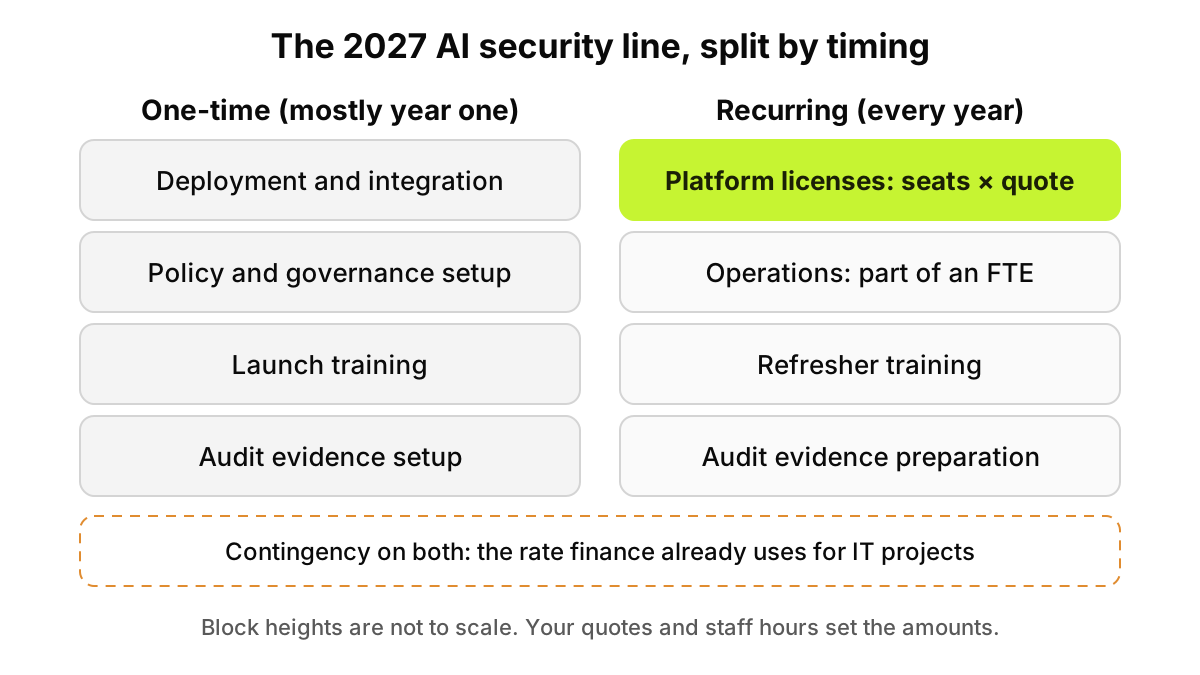
Figure 1. The seven line items, split by whether they come back next year; training and audit evidence appear on both sides. Block heights are not to scale; your quotes and hours set the real proportions.
Why should AI security be its own budget line?
Because a separate line is more likely to grow, and a buried one tends to get spent by somebody else. The clearest evidence is the 2026 Security Budget Benchmark from IANS Research and Artico Search, drawn from more than 500 CISOs. Only 24% of organizations track AI as a separate line item or security-budget subcategory. Another 38% embed it in the broader security budget, and 38% fund it through IT, data or innovation budgets.
Outcomes follow the structure. In its 14 September 2026 summary, IANS says about 70% of organizations with a formal line item or subcategory reported increased AI funding, compared with 42% where AI was embedded in the security budget and 31% where it was funded elsewhere. That is a survey correlation, not proof of cause. It still shows which structure your peers win with.
The wider picture is tight. The same summary puts average security budget growth at 5% in 2026, with the median at 0% for the second year running and 55% of CISOs reporting flat or declining budgets. The benchmark landing page adds that 64% of CISOs asked for an increase in 2026 and 45% received one.
Other sources point the same way, from different samples. PwC's 2027 Global Digital Trust Insights (1 October 2026, 3,934 business and tech leaders in 71 countries) found that 84% of security and finance leaders expect budgets to increase and 58% of security leaders rank AI among their top cyber budget priorities. A Gartner press release of 26 August 2026 projects the market for securing AI to reach almost $4.8 billion in 2027, a 68.7% increase over 2026. Gartner's 2027 trends page (20 October 2026) puts it in one line: "In 2027, the conversation shifts from adoption to governance."
None of these figures is a reason to spend. They answer the finance partner who asks whether peers are doing this. Your reasons are your own risks and your own deadlines.
What goes in the line?
Seven items. Most first drafts carry only the license, and the request runs short by spring, when someone has to pay for the rollout, the policy work and the audit prep.
Line item
One-time or recurring
Size it from
Who supplies the number
Platform licenses
Recurring (annual)
Seats in scope × the per-seat price in the written quote; list agents separately if the quote prices them
Vendor quote; identity team for seats
Deployment and integration
Mostly one-time
Engineer hours for MDM rollout, identity and SIEM integration × loaded hourly rate
Endpoint and identity leads; finance for the rate
Policy and governance work
One-time setup, small recurring
Hours to write the acceptable use policy, set up the committee and run quarterly reviews
GRC lead, legal, the DPO
Employee training
Launch once, refresh yearly
Employees × training minutes × loaded rate, plus any bought content
HR or learning team
Ongoing operations
Recurring
A fraction of an FTE for alert triage, policy tuning, exceptions and monthly reporting
SOC or security engineering manager
Audit evidence preparation
Setup once, preparation recurring
Hours per audit or regulator request × requests expected in 2027
Internal audit, compliance
Contingency
Both
The rate finance already applies to IT projects
Finance
The last column does the most work. A CFO trusts a figure from a quote, a headcount report or a named manager. They are right to distrust one taken from an analyst's average.
How do you size each item from your own numbers?
Start with seats, because the rest scales from them. Count the people who will run the browser extension or desktop app, not total headcount. Contractors with corporate identities count. Service accounts do not, unless the vendor prices AI agents, in which case list those on their own row.
Then get two written quotes. Not a slide, not a range from a first call: a quote with a unit, a term and a renewal clause. Per seat per year makes the license row simple multiplication. A platform fee needs a note on what it covers and at what volume it changes.
Staff time is where drafts go wrong, usually by leaving it out because the people are "already paid for." They are also pulled off other work, and a finance team that finds a year of hidden effort later will trust your next request less. Ask each owner for hours, multiply by the loaded rate finance gives you, and show it as an internal cost even though no cash moves.
Audit evidence grows quietly. Count the 2027 requests: internal audit, the external auditor's AI questions, customer security questionnaires, any regulator inquiry. Ask compliance how long the last one took. Multiply.
Contingency comes last, at the rate finance already uses. Say so in the memo.
Our free AI security budget calculator does this arithmetic: enter your seat count, vendor quote and staff time, and it totals the line by category, splits year one from year two, and drafts the budget memo. It is useful here because every figure it produces traces back to an input you can name.
What is one-time, and what recurs in year two?
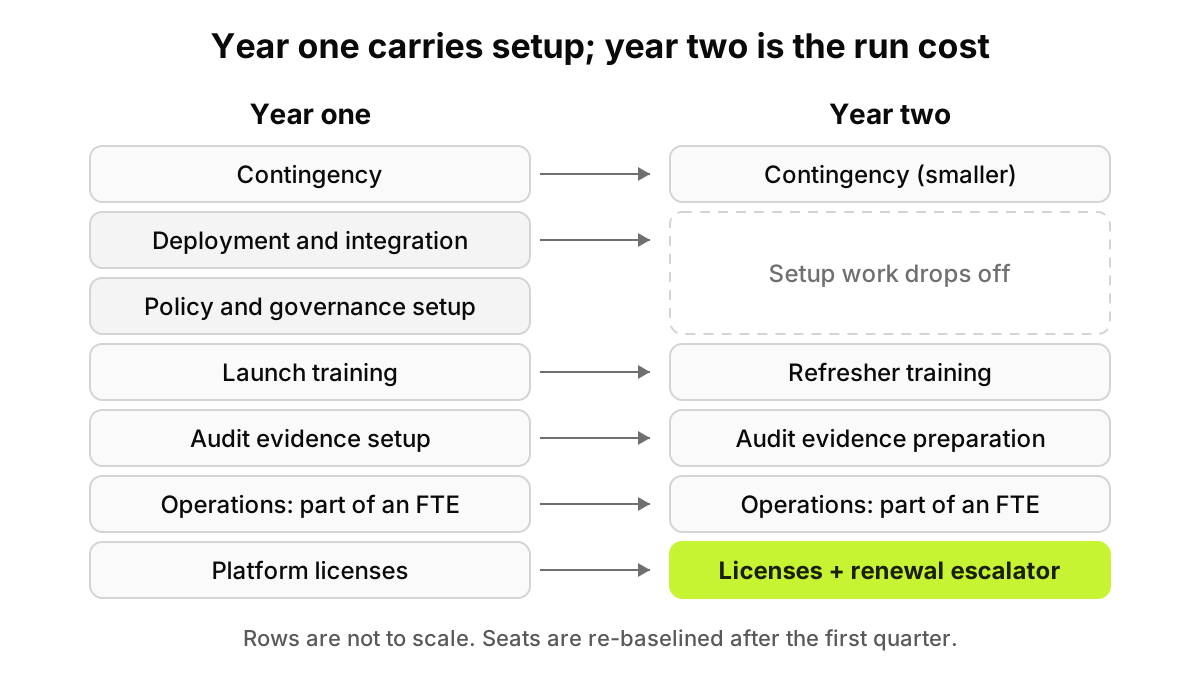
Year one carries the whole stack. Year two keeps licenses, operations time, refresher training, audit preparation and a smaller contingency, and drops most of the setup work.
Show both years on one page. A request with only year one looks larger than it is; one with only the run rate looks like it hides the setup. Finance will build the two-year view anyway, so build it first, with the renewal escalator from the quote included.
Figure 2. The one-time items fall away after year one, so the year two figure is the run cost finance should plan to carry.
One caution. Seat counts tend to rise once discovery shows how many people already use AI tools, so the year two license row can exceed year one even as setup costs vanish. Note in the memo that seats will be re-baselined after the first quarter.
What does the CFO actually read?
One paragraph, often the first and sometimes the only one. Write it to survive being pasted alone into a budget committee pack. Replace everything in brackets:
We request [total] for fiscal 2027 as a separate AI security line, of which [one-time amount] is one-time and [recurring amount] recurs. It covers [seat count] employees and [number] AI agents, based on [discovery source and date]. It addresses three named risks: [risk one, for example customer records pasted into personal AI accounts], [risk two] and [risk three]. It supports dated obligations including [obligation and date]. In year one it buys [two or three outcomes]; from year two the run cost is [recurring amount]. Without it, [the specific consequence, for example we cannot show what data reached which AI tool when the auditor asks]. We will report [two or three metrics] to [committee] each quarter.
Name risks the CFO can picture, not framework categories. Name the metric too, because a line that promises nothing measurable is the first one trimmed. Our board questions guide makes a point that holds for finance as well: show the risk picture first and let the number follow.
Which 2027 obligations make the line non-optional?
Keep this part short and dated. Three examples, each checked against the primary text:
EU AI Act.Regulation (EU) 2026/1744, the Digital Omnibus on AI, has high-risk obligations for Annex III systems apply from 2 December 2027. The Article 5 prohibitions it adds apply from 2 December 2026, the same date by which providers of generative systems placed on the market before 2 August 2026 must meet Article 50(2) marking. Preparing for December 2027 is 2027 spending.
California. Under section 7200(b) of the CCPA regulations, a business using automated decisionmaking technology for a significant decision before 1 January 2027 must comply with the ADMT article no later than that date. Where cybersecurity audits are required, section 7121 sets the first report for 1 April 2028 if 2026 annual gross revenue was more than $100,000,000, covering 1 January 2027 through 1 January 2028. That audit period is your budget year.
Colorado.SB26-189, signed 14 May 2026, requires developers of covered automated decision-making technology to give deployers technical documentation starting 1 January 2027, and both must keep compliance records for at least 3 years.
Add your sector regulator's dated items. For every date we could verify through mid-2027, use our AI compliance calendar. This is not legal advice; ask counsel which of these applies to you.
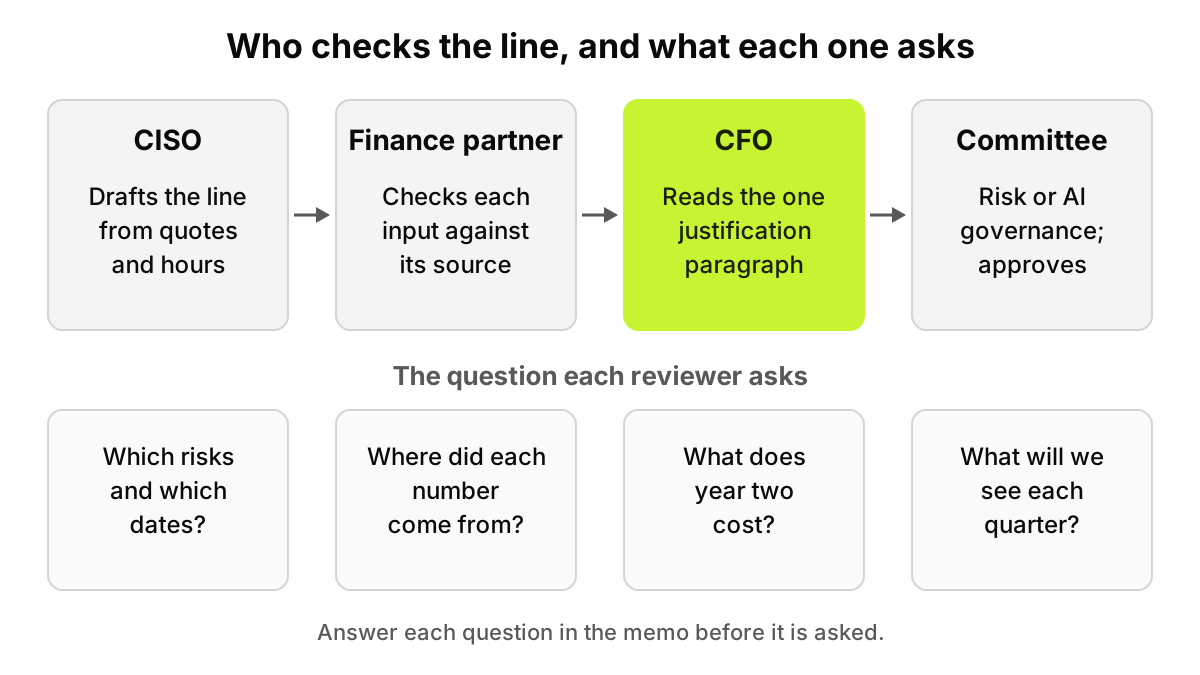
Figure 3. Each reviewer checks something different. Preparing for each question is faster than rewriting the request after it comes back.
If the line is trimmed, what do you cut first?
Decide before you submit, so the cut is yours. Our order:
Bought training content. Use a short internal briefing and the on-screen notices people see when a policy applies. Keep the hours; drop the purchase.
Scope, by phase. Cover teams handling customer data, source code and financials in the first half, everyone else in the second. Seats drop; the control stays.
Integration extras. SIEM dashboards and custom reports can wait a quarter. Identity integration cannot.
Contingency. Only if finance agrees that overruns return as a separate request.
Do not cut the inline control, the inventory or the audit log. Those three are what the dated obligations ask you to show, and they cost most to rebuild in a hurry. If the request must shrink further, shrink seats and say which groups wait.
What should you do this week?
Get the seat count from your identity provider, and note the date.
Ask two vendors for written quotes with unit, term and renewal escalator.
Collect hours from each owner: endpoint, identity, GRC, HR, SOC, compliance.
Run the numbers through the calculator and fill in the CFO paragraph.
Write down your cut list before anyone asks for it.
Where does software help with the budget, and where does it stop?
Software cannot set your number, pick your risks or argue for the line. It cannot make you compliant with any law above. Those calls belong to the CISO, the CFO and counsel.
It can make the inputs honest. AccuroAI discovers 1,400+ AI tools with the signed-in account and plan, so seat counts and the split between personal and company accounts come from data rather than guesses. It redacts PII, account numbers, card data and 60+ secret types in line, with 40+ classifiers in under 38 ms p99, so the control you fund acts instead of only reporting. And it keeps admin and employee audit logs with evidence mapped to 8 frameworks, the raw material for your audit evidence hours. It deploys in under 30 minutes.
FAQ
How much should we budget for AI security per employee?
There is no honest single number: vendors price by seat, agent, usage or platform fee, and most publish nothing. Use the method instead. Multiply your seat count by the per-seat price in a written quote, add staff hours at your loaded rate, then contingency. Divide by seats afterward if finance wants a per-employee figure.
Should AI security sit in the security budget or the AI program budget?
Give it its own line inside security, owned by the CISO. In IANS Research's 2026 data, about 70% of organizations with a formal AI line reported increased AI funding, against 42% where AI was embedded in the security budget and 31% where it was funded elsewhere. That is correlation, not proof, but it is the best public signal.
How do we justify the line if we have not had an AI incident?
Tie it to dated obligations and named risks instead. California's ADMT compliance date of 1 January 2027 and the EU's December 2027 high-risk date both call for evidence you can produce only if controls run beforehand. Then name a risk the CFO can picture, such as customer data pasted into a personal AI account.
Do we still need the line now that EU high-risk rules moved to December 2027?
Yes, if those rules apply to you, because the preparation happens during 2027 and is funded in this cycle. The move changed the deadline, not the work. California's ADMT requirements and Colorado's SB26-189 documentation duty start on 1 January 2027 regardless of the EU change.
What should we report once the line is approved?
Report two or three numbers the committee can follow each quarter: AI tools discovered against tools approved, sensitive data redacted or blocked before it reached a model, and time taken to answer an audit request. Pick the ones your justification paragraph promised, and keep the definitions fixed so quarters compare.