DSPM vs AI Usage Control: Which Question Each One Answers
DSPM and AI usage control answer different questions. DSPM finds sensitive data at rest and maps who can reach it; AI usage control sees what people and agents send to AI at the point of use, and what each agent on a laptop can do. We compare them on eleven CISO questions, note where DSPM vendors add browser or endpoint components, and set out which to start with.
D
Dr. Marcus Chen
Principal Security Researcher
Oct 31, 2026
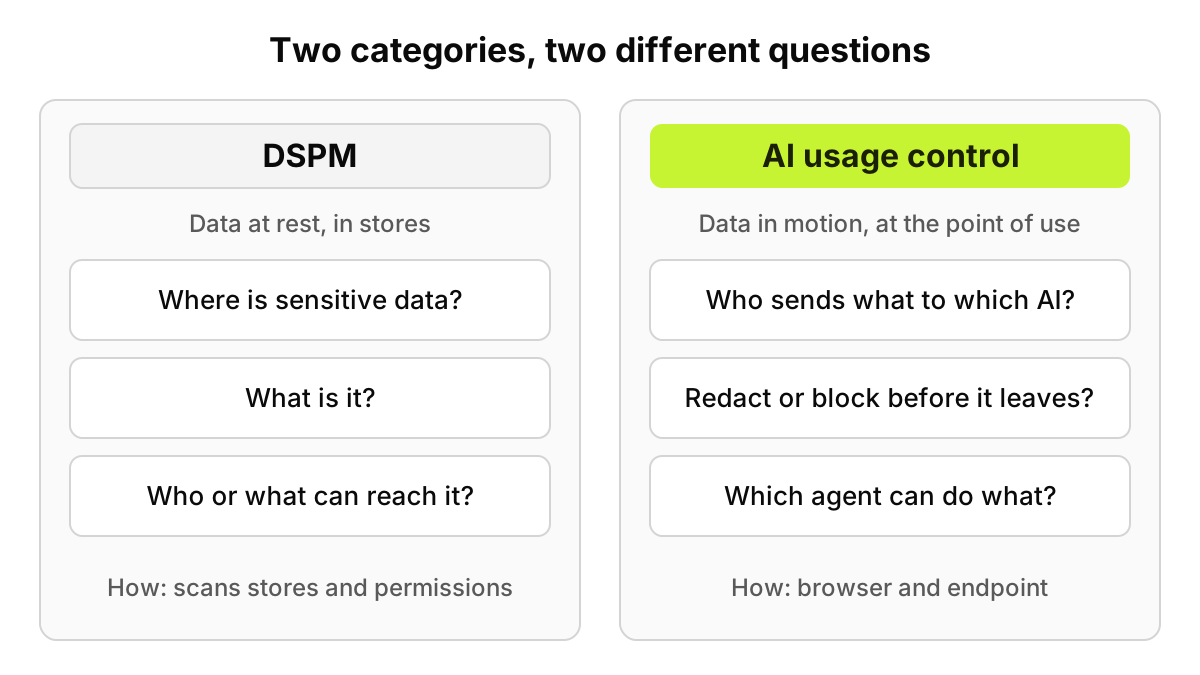
DSPM and AI usage control answer different questions. DSPM asks where sensitive data sits in your stores, what it is, and who or what can reach it. AI usage control asks who is sending what to which AI tool right now, and what the agents on a laptop are able to do. Most mature programs need both.
The real decision is the order.
Buyers are asking because data security platforms keep adding modules: DLP, then identity, and now AI agents. So the budget question is fair: does one DSPM purchase cover AI? It depends on which question you need answered first.
Last verified: 31 October 2026, against the Model Context Protocol specification, the Cloud Security Alliance report page and the AccuroAI product as it ships today.
Figure 1. One category looks at stores and permissions; the other looks at the moment data is handed to an AI tool or an agent.
What question does DSPM answer?
Data security posture management is about data at rest, and vendors say so in their own documentation.
A DSPM platform starts from the data, not from the device. It connects to cloud and SaaS stores, usually through APIs and without installing anything, then finds and classifies sensitive records and maps which people, roles and service accounts can reach them. Its scope typically runs from object storage, file shares and databases to warehouses and analytics platforms. The questions it answers are short ones. What data do we have? Where is it stored? Who can access it? How is it protected?
The shape is a scanner that connects to stores, classifies, maps access and flags over-exposure.
That work is valuable, and nothing at the point of use replaces it. Before an assistant is switched on for the whole company, a DSPM review can find the overshared sites and folders it would otherwise surface to anyone who asks. Some vendors now extend DSPM toward data in motion through DLP modules, but the core question holds. Where is the data, and who can get to it?
What question does AI usage control answer?
AI usage control (AIUC) looks at data in motion at the point of use. In our explainer on the category, we define it as software that finds the third-party AI tools employees use, sanctioned or not, and enforces the organization's rules on what may be typed, pasted or uploaded into them while it is happening. Its questions:
Who is using which AI tool, on which account and plan?
What is about to leave in this prompt, paste or upload, and should it be redacted or blocked?
Which agents, MCP servers and IDE extensions run on this laptop, and what can each one do?
What did an agent just try to run?
The agent questions matter more every quarter. The Model Context Protocol specification says MCP servers "expose tools that can be invoked by language models," for example "querying databases, calling APIs, or performing computations." No store scan will find those on a laptop.
How do DSPM and AI usage control compare, question by question?
Eleven questions a CISO actually asks. "Partly" means the answer depends on added components or on how a vendor has extended its product.
Question
DSPM
AI usage control
Notes
Where is customer PII stored?
Answers: scans and classifies stores
No: does not inventory data at rest
DSPM's home ground.
Is a SharePoint site overshared before a Copilot rollout?
Answers: oversharing and access assessments
No: does not read site permissions
Fix exposure before the assistant can reach it.
Which service accounts can read the finance database?
Answers or partly: maps identities to data access
No: does not manage service accounts or keys
Identity tools also answer this.
Which employees use personal ChatGPT accounts?
Partly: only with an added browser or endpoint component
Answers: sees the signed-in account
Ask what must be installed, on which browsers.
Did someone paste a customer list into Claude?
Partly: same condition
Answers: inspects the paste before it leaves
Redacting in line beats a report later.
Is a file being uploaded to Gemini right now?
Partly: through endpoint or browser DLP, where deployed
Answers: upload allowed or blocked by policy
Check whether the default policy only audits.
Which MCP servers on developer laptops can send data externally?
No, by design: laptops are not stores
Answers: per-server capability tags
Some data vendors now sell agent modules.
Which agent ran a destructive command?
No
Answers: command captured, alert raised
Tie it to the person and device.
Can a coding agent write to our code repository?
No
Answers: "code repository writes" tag
Keep branch protection too.
Should our internal LLM agent take this action for this user?
Partly: can show its training or RAG data is sensitive
No: governs third-party AI use
A runtime check in your own app answers this.
What evidence goes to the auditor?
Partly: posture, exposure, remediation history
Partly: per-event logs of AI use and agent actions
Neither is the whole file.
Where do they overlap, and what can each one not see?
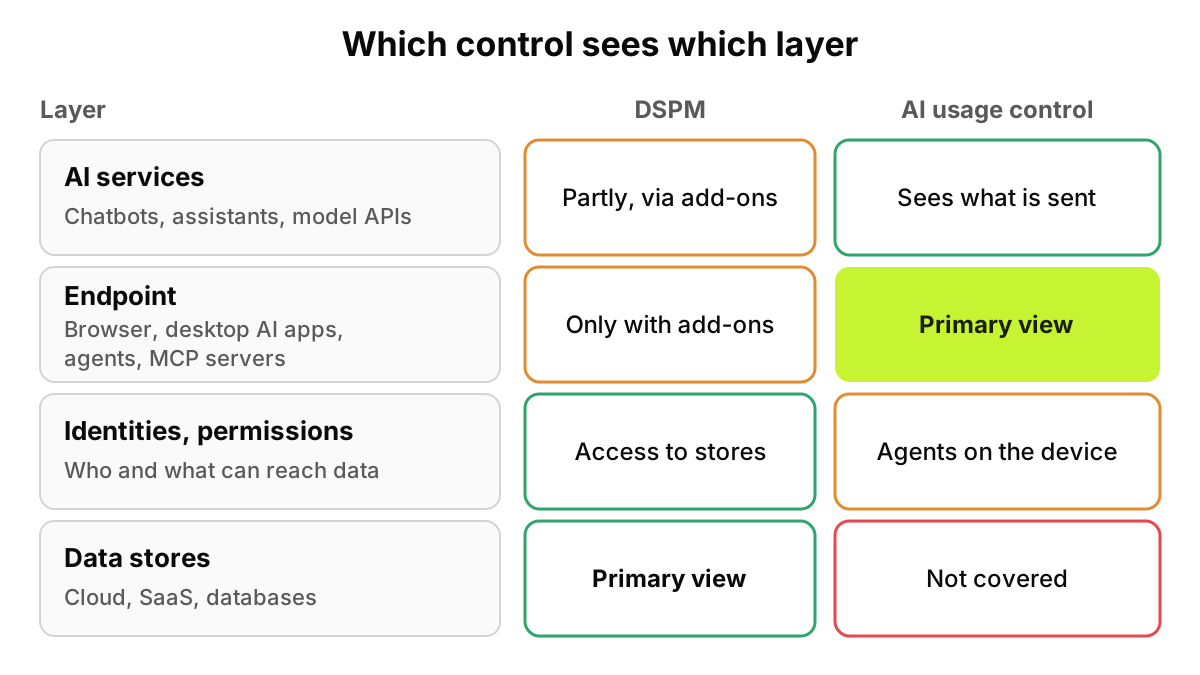
By design, a DSPM scanner does not see a paste into a personal AI account on a laptop. It reads stores and permissions. A browser tab is neither.
Some vendors now sell browser or endpoint components that reach across that line. Before counting on one, ask four things: what has to be installed on each device, which browsers and operating systems it covers, whether it can tell a corporate account from a personal one, and whether its AI policy redacts and blocks or only audits. The last answer matters most at the point of use. AccuroAI's browser extension for Chrome and Edge scans each prompt before it reaches any generative AI tool or LLM and redacts sensitive data in line, in under 38 ms p99. When it blocks a file upload, the event records what it found and where, such as an email address on line 1 of a .docx file.
So the honest line runs between what DSPM covers by design and what a vendor sells next to it. Ask which component answers the question, what it needs installed, and whether it enforces or only reports.
The limit runs the other way too. AI usage control does not inventory data at rest. It cannot tell you that an old customer export sits in a forgotten bucket, or that a finance share is open to the whole company. AccuroAI does not scan data stores and is not a DSPM.
Both classify sensitive data. Where the control sits, not its classifier, decides what it can stop.
One more overlap is easy to miss: the AI your own teams build. DSPM can tell you that the RAG index behind an internal assistant holds sensitive data. It cannot tell you what that assistant does with a particular request. AccuroAI answers that runtime question with its AI agent security product, which integrates with internal LLM applications and agents through an SDK: each request is checked inline for identity, authorization, action and risk, scanned for prompt injection, and given a verdict of Allowed, Redacted, Held for approval or Blocked.
Figure 2. DSPM is strongest at the bottom two layers; AI usage control is strongest at the endpoint, where data is handed to AI.
Are AI agents a DSPM problem or an endpoint problem?
Both, which is why non-human identity pulls the two categories together.
An AI agent is an identity with access to data. DSPM sees the data side: which identities, human or not, can reach which stores, and identity vendors are adding controls over which workloads and agents can reach which systems. Our piece on the NHI consolidation covers the deals.
The endpoint side looks different. A coding agent runs under the developer who installed it, and nobody registered it. That is common: 82% of organizations discovered previously unknown AI agents in the past year, according to a Cloud Security Alliance survey commissioned by Token Security and published in April 2026.
AccuroAI treats agents, MCP servers and IDE extensions on the endpoint as identities. Each is tied to the person and device it runs under, together with what it is able to do.
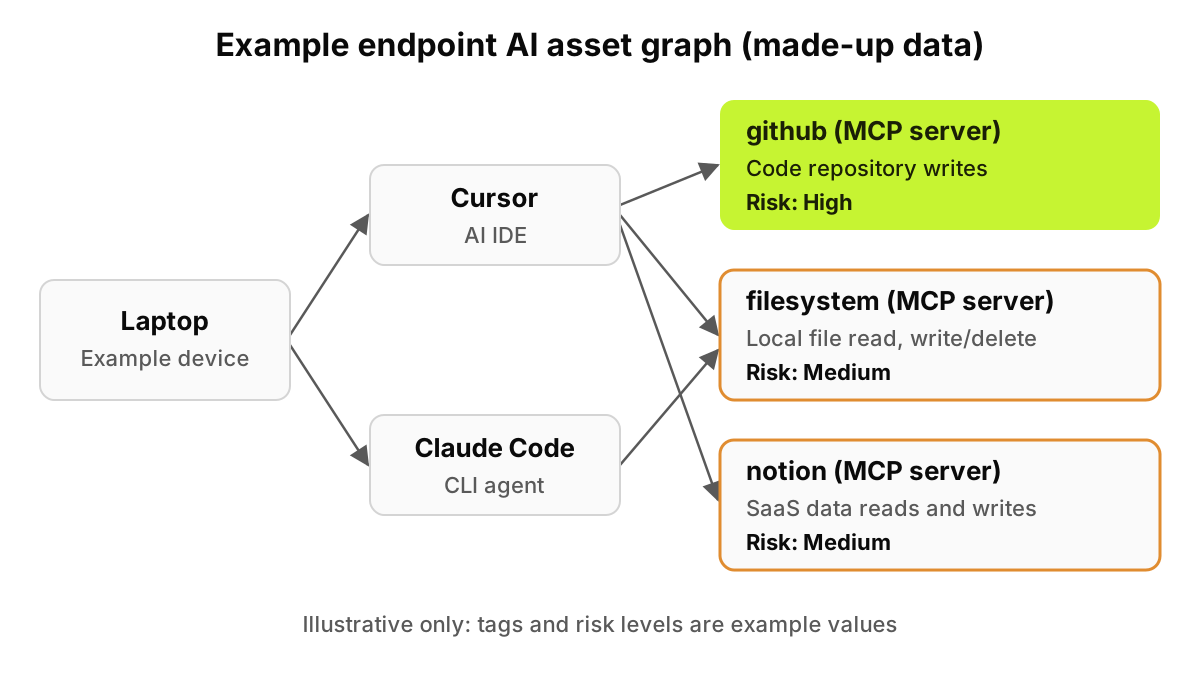
In practice that is an AI assets graph per device. Take a made-up laptop belonging to David Kim: it runs Cursor and Claude Code, and Cursor connects to github, filesystem and notion MCP servers. Each server gets a risk score and capability tags such as "sends messages externally," "SaaS data reads and writes," "local file write/delete" or "code repository writes." Findings flag a "read plus exfiltrate combination," third-party servers and unpinned package versions, and tool descriptions are scanned for hidden instructions. When an agent runs a destructive command, it is captured and an alert goes out. Our shadow MCP guide explains why this has to come from the device.
Figure 3. An illustrative device graph. It answers not where data lives but what this machine's agents can do with it.
How do DSPM and AI usage control work together?
Treat this as a pattern, not an integration either side has promised:
DSPM tells you which data is sensitive and where it sits. That shapes the classes your AI policy protects.
Point-of-use controls redact or block it when someone sends it to AI. AccuroAI enforces by signed-in account, so personal ChatGPT can be blocked while ChatGPT Enterprise keeps working. It redacts PII, account numbers, card data and 60+ secret types in line, with 40+ classifiers, in under 38 ms p99, and blocks file and image uploads by policy.
Audit logs from both land in the SIEM. AccuroAI streams admin and employee audit logs to Splunk, Microsoft Sentinel, Google SecOps, IBM QRadar, Elastic and most others.
Which should you put in place first?
Start with DSPM when you do not know where regulated data lives, an assistant rollout is weeks away and permissions are messy, or an auditor wants a data inventory.
Start with AI usage control when employees already use AI on personal accounts, developers run coding agents with MCP servers, or you need to stop a paste this month rather than report on it next quarter.
Run both when you hold regulated data at scale and AI use is already broad. Most large enterprises are here.
If people and coding agents already send data to AI, point-of-use control is usually the faster first step: a blocked upload pays off the day it happens.
Is DSPM for AI the same as AI-SPM?
No. DSPM for AI applies data posture to AI interactions and to the data assistants can reach. AI-SPM inventories and scores the models, pipelines and agents your teams build. AI usage control governs use at the moment it happens. Three categories, three objects.
What can software do, and where does it stop?
No product decides which data may reach which AI tool. The CISO, the DPO and the business write that rule. Someone still has to own the remediation queue a DSPM produces, and no tool makes an organization compliant with a law or a standard.
Each category acts at its own position. A DSPM finds the over-exposed store and the identities that reach it. AccuroAI sees the account, the prompt and the upload, redacts or blocks before data leaves, maps each device's agents and MCP servers with what they can do, and sends the record to your SIEM.
What should you do now?
Write down your top three questions from the table. Stores and permissions point to DSPM first; prompts, uploads and agents point to the point of use.
Ask every vendor which component answers which row, what it needs installed, and whether its default policy blocks or only audits.
Inventory agents and MCP servers on developer laptops. Our AI agent governance framework helps here because it turns the agent and identity controls into a checklist you can score that inventory against.
Set account-level rules for the main assistants: which enterprise accounts are allowed, and what happens on a personal one.
Pick which data classes are redacted and which are blocked, using DSPM classification where you have it.
Route both log streams to the SIEM.
See it on your own devices. A 72-hour pilot maps the AI already in use before any policy is enforced. Request a pilot, or see our endpoint AI governance page.
FAQ
What is the difference between DSPM and AI usage control?
DSPM finds sensitive data at rest in cloud, SaaS and on-premises stores, classifies it and maps who can reach it. AI usage control works at the point of use: it sees which AI tools and accounts people use, inspects what they paste or upload, and maps the agents and MCP servers on each device. One answers where data is; the other, where it is going.
Can DSPM see what employees paste or upload into ChatGPT?
Not by design, because a scanner reads stores, not browser tabs. Some vendors add a browser or endpoint component that can. Ask what must be installed, which browsers are covered, whether it separates corporate from personal accounts, and whether the policy redacts and blocks or only audits what was pasted.
Does DSPM cover AI agents and MCP servers?
DSPM covers the data side: which identities, including agents, can reach which stores. By design it does not list the MCP servers a developer connected to a coding agent on a laptop. Some data security vendors now sell separate agent modules, so ask whether they show each server's capabilities and the person and device it runs under.
Do I need DSPM if I have AI usage control?
Probably, if you hold regulated data at scale. AI usage control does not inventory data at rest, so it cannot tell you that an old export sits in an open bucket or that a site is overshared before a Copilot rollout. The reverse holds too: DSPM alone does not stop a paste into a personal AI account.
Is DSPM enough to stop shadow AI?
Not on its own. Shadow AI is a point-of-use problem: unapproved tools, personal accounts and agents nobody registered. A DSPM reduces the damage by shrinking over-exposed data, but stopping the paste, the upload or the agent action needs a control on the browser or endpoint where it happens.
This is not legal or audit advice; ask your auditor or counsel what your control set has to evidence.