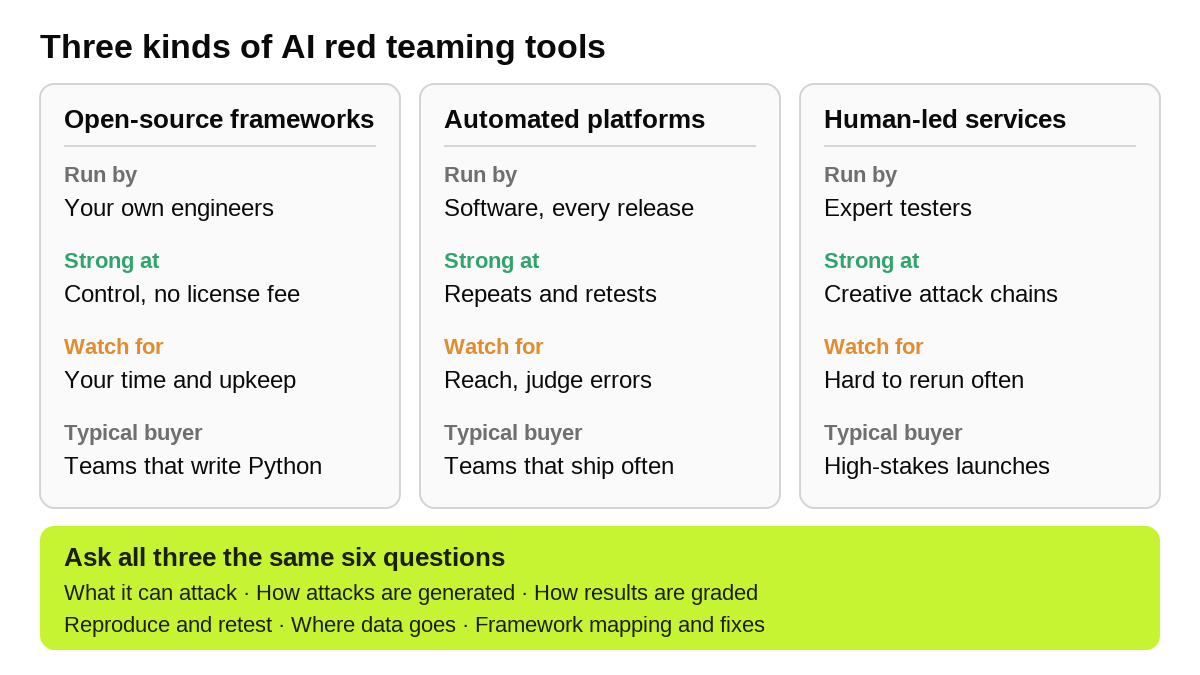
AI red teaming tools attack your AI system on purpose, the way an adversary would, and record what broke. They send hostile prompts, plant instructions in content the system reads, and watch what the model says and what an agent does with its tools. A buyer will meet three kinds: open-source frameworks you run yourself, automated commercial platforms, and human-led services. Six things separate them: what they can attack (a model, an app, an agent with tools, an MCP server), how attacks are generated (a fixed list or adaptive multi-turn conversations), how results are graded, whether a finding can be reproduced and retested, where your prompts and data go, and how findings map to frameworks and turn into fixes.
Below: a fair comparison, a 31-question RFP checklist, weights for three types of buyer and a two-week proof of value. We sell one of these tools, and a section near the end says where it fits and where it does not.
Last verified: 28 November 2026, against the microsoft/PyRIT and NVIDIA/garak repositories, two OWASP GenAI pages, MITRE's ATLAS data repository, NIST AI 100-2e2025 (PDF text) and Article 55 on the Commission's AI Act Service Desk, all primary. The comparison, checklist, weights and proof-of-value method are our own.
What are the three kinds of AI red teaming tools?
Open-source frameworks you run yourself. PyRIT lives in the microsoft/PyRIT repository, which describes it as an "Open-source AI red teaming toolkit from Microsoft", built by the Microsoft AI Red Team and outside contributors under the MIT license, with automated scans and adaptive multi-turn attacks. garak lives in the NVIDIA/garak repository under the Apache 2.0 license and calls itself "the LLM vulnerability scanner". It pairs probes, which generate interactions with a model, with detectors that decide whether a failure occurred.
The category is strong on control: no license fee, attacks you can read as code, and a tool that runs inside your own environment. The cost is engineering time. Someone has to host it, connect each target, and build the reporting and retest workflow. The typical buyer has security engineers who write Python.
Automated commercial platforms. NIST AI 100-2e2025 says automated model-based red teaming "employs an attacker model, a target model, and a judge". A platform packages that loop with connectors, schedules, a release gate, reports and retests. Its strength is repetition: the same attacks run on every release with little engineering effort. It attacks only what it was built to reach, its judge can be wrong, a hosted platform sends your transcripts to the vendor, and software is less inventive than a skilled person. The typical buyer ships AI features often.
Human-led services. Expert testers bring what automation lacks: creativity, knowledge of your business rules, and chains of small weaknesses nobody scripted. NIST AI 100-2e2025 lists targeted expert red teaming and bug bounties beside broad automated vulnerability assessments as forms of evaluation. The limits are cost per engagement, calendar time, and a result that is hard to rerun on the next release. The typical buyer has a high-stakes launch or a new architecture.
None of the three replaces the others.
Which questions belong in an AI red teaming RFP?
Send the same questions to every vendor, answer them yourself for any open-source option, and ask for evidence with each answer. Our earlier AI Agent Security RFP covers runtime controls for agents; the checklist below covers the tools that test them.
| Question | What a good answer looks like | Red flag |
|---|---|---|
| 1. Scope and targets | ||
| Q1. Which targets can you attack: a model by API, a chatbot or RAG app, an agent with tools, an MCP server? | A list per type, with how each connects | "Any AI system" |
| Q2. Can you reach a target behind a login or on a private network? | Named methods and what each needs from us | Public API endpoints only |
| Q3. Which inputs do you attack besides the prompt: retrieved documents, tool output, memory, tool descriptions? | Indirect injection through each named input | Direct prompts only |
| Q4. What is out of scope? | A written exclusions list | No exclusions offered |
| 2. Attack generation | ||
| Q5. Are attacks a fixed library, written by an attacker model, or both? | Both, with which is used when | Will not say |
| Q6. Do attacks run over several turns and adapt to each reply? | A sample multi-turn transcript | Single prompts described as conversations |
| Q7. Can we add our own attack goals, policies and forbidden actions? | Custom objectives per target | Vendor-defined harms only |
| Q8. How many times is each attack attempted? | Configurable repeats, results per attempt | One attempt, pass or fail |
| 3. Agent and tool testing | ||
| Q9. Do you judge the tool calls an agent attempts, or only its text? | Tool name and arguments recorded per finding | Text-only grading for agents |
| Q10. Do you test under several user roles? | A standard user tried against admin tools | One identity for every test |
| Q11. Can you test MCP servers for hidden instructions in tool descriptions? | Yes, through a live agent session | Description review with no agent session |
| Q12. How do you prevent real side effects during a test? | Staging targets, sandboxed tools, scoped credentials | No guidance on safe targets |
| 4. Grading and false positives | ||
| Q13. What decides success and severity: rules, a judge model, a person? | The method and severity criteria, visible on each finding | An unexplained score |
| Q14. How do you measure false positives? | A method we can repeat on our own target | One headline percentage |
| 5. Reproducibility and retest | ||
| Q15. Does each finding include the full transcript and reproduction steps? | Enough for our engineer to replay it by hand | Summary only |
| Q16. Can the exact attack be rerun after a fix? | A retest per finding, both runs kept | A fresh scan offered as the retest |
| Q17. Are runs comparable across releases? | A versioned attack set and a diff | Results shift with no explanation |
| 6. Data handling and deployment | ||
| Q18. Where does the tool run: our cloud, yours, on-premises, air-gapped? | A plain yes or no per option | "Flexible deployment" |
| Q19. Where do our prompts, transcripts and credentials go, and for how long? | Named regions, a retention period, deletion on request | No retention answer |
| Q20. Which model providers see our data? | A named subprocessor list | Undisclosed third-party models |
| Q21. Is our data used to train your models? | No by default, written into the contract | An opt-out buried in terms |
| 7. Framework mapping and reporting | ||
| Q22. Which frameworks are findings mapped to, and at what level? | Entry or technique ids on each finding | A page of logos |
| Q23. Can an outside auditor follow the report? | Scope, dates, method, retest status, what was not tested | Dashboard screenshots only |
| 8. Integration and release gating | ||
| Q24. Can a run block a release from our CI/CD pipeline, and run on a schedule? | A documented step with a threshold we set | Manual runs only |
| Q25. Where do findings go: ticketing, chat, an API? | What exists today, separate from plans | Roadmap items listed as features |
| Q26. Does each finding come with a fix our engineers can apply? | Specific guidance per finding | "Improve the system prompt" every time |
| 9. Pricing model and limits | ||
| Q27. What is the pricing unit: target, run, attack, seat or engagement? | One unit, priced at our expected volume | The unit changes after the proof of value |
| Q28. What limits apply to targets, runs, turns and retests? | Limits written in the order form | Fair-use language only |
| 10. Vendor proof | ||
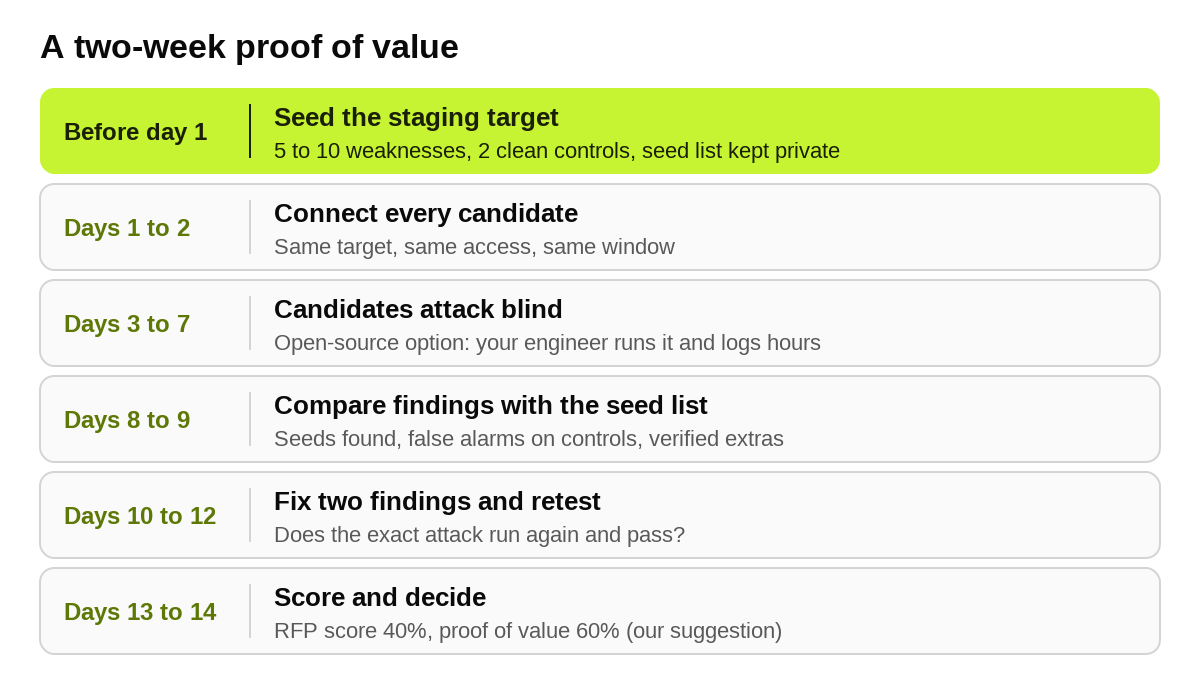
| Q29. Will you run a proof of value against our seeded staging target? | Yes, blind, under our rules | The vendor's demo environment only |
| Q30. What is the product's release status? | General availability, beta or preview, stated plainly | Status unclear |
| Q31. What can your tool not find? | A specific list | "Nothing" |
Q8 matters because models are not deterministic: an attack that fails once may succeed on the fifth attempt.
How should you score the answers?
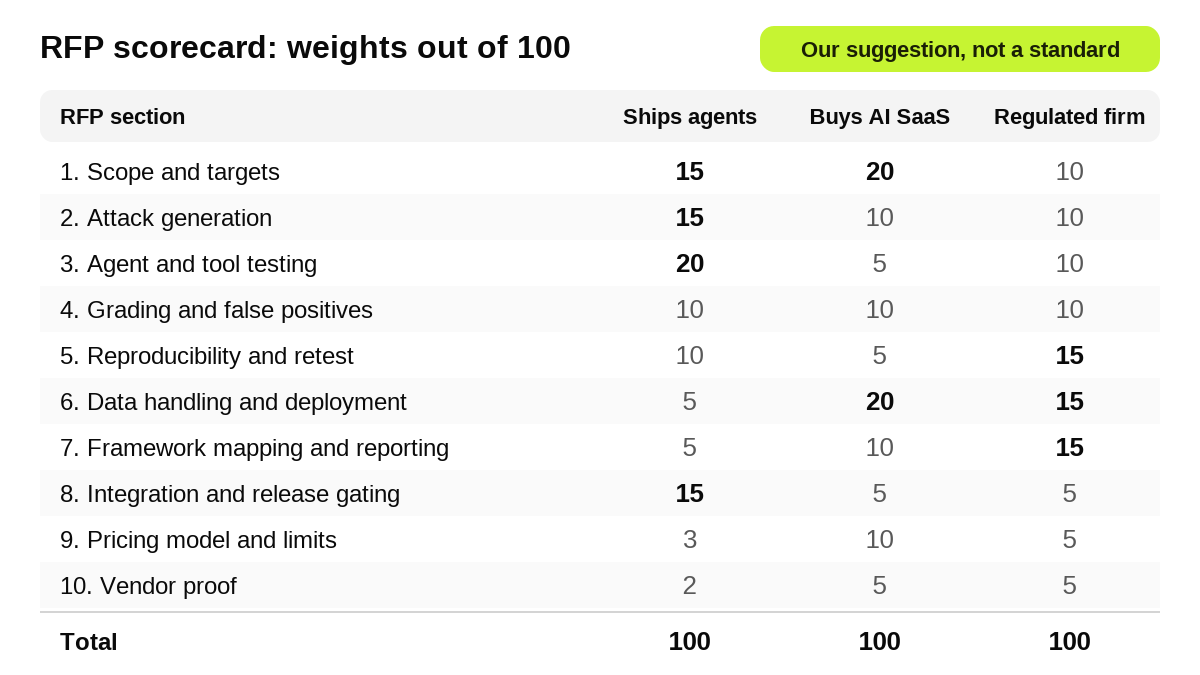
Score each answer 0 for no or no evidence, 1 for partial or planned, and 2 for yes with evidence. Divide each section's points by its maximum and multiply by the section weight. The weights are our suggestion, not a standard.
A team shipping its own agents should weight agent and tool testing, attack generation and release gating most, because it releases often and its exposure is what an agent does. A company that mostly buys AI SaaS cares first about scope (can the tool reach an app it does not own, and does the provider permit testing?) and data handling. A regulated firm that needs audit evidence should favor reproducibility, reporting and data handling, since an auditor will ask how a finding was produced and whether the fix was checked.
Paper answers should count for less than observed results. We suggest 40% of the decision for the RFP score and 60% for the proof of value, again our judgment.