Post-Quantum Readiness for AI Systems: What Harvest-Now-Decrypt-Later Means for Prompts, Agent Credentials and Model Data
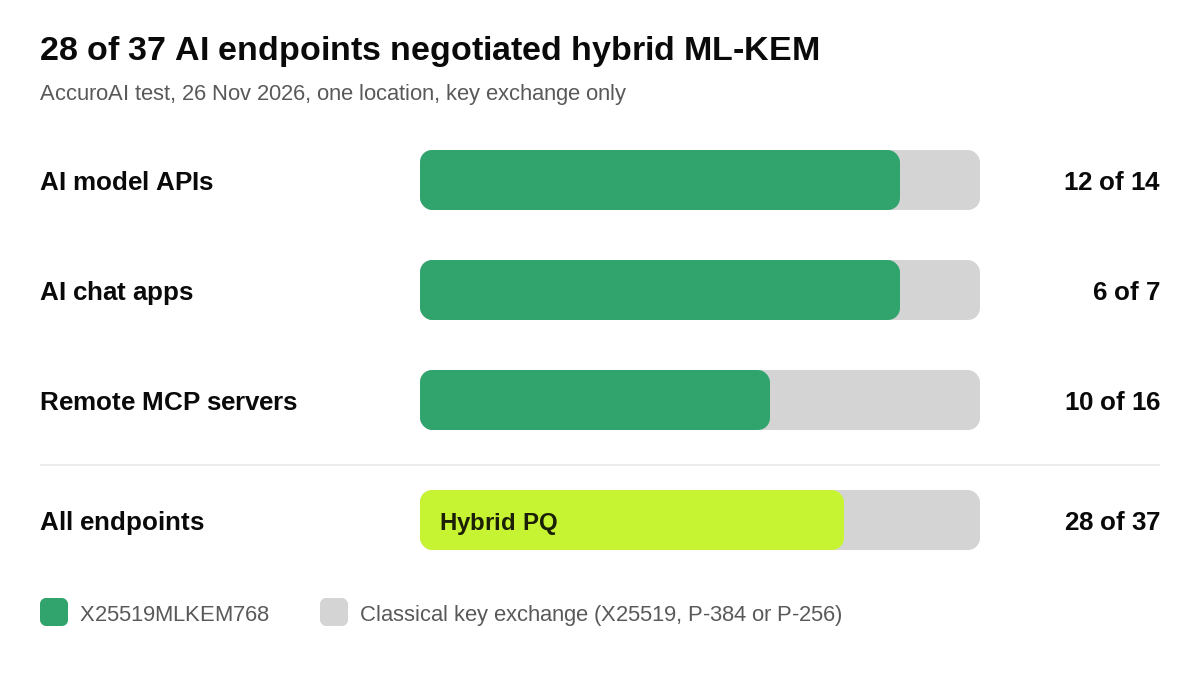
Harvest-now-decrypt-later means traffic recorded today could be decrypted once a large enough quantum computer exists, and for AI that puts long-lived prompts, RAG corpora, training data, weights and credentials at risk. In our 26 November 2026 test, 28 of 37 AI endpoints already negotiated hybrid X25519MLKEM768, including 12 of 14 model APIs, but only 10 of 16 remote MCP servers did. Old client runtimes and TLS-terminating proxies can silently fall back to classical key exchange, so the inventory has to cover both ends.
D
Dr. Marcus Chen
Principal Security Researcher
Nov 26, 2026
On this page
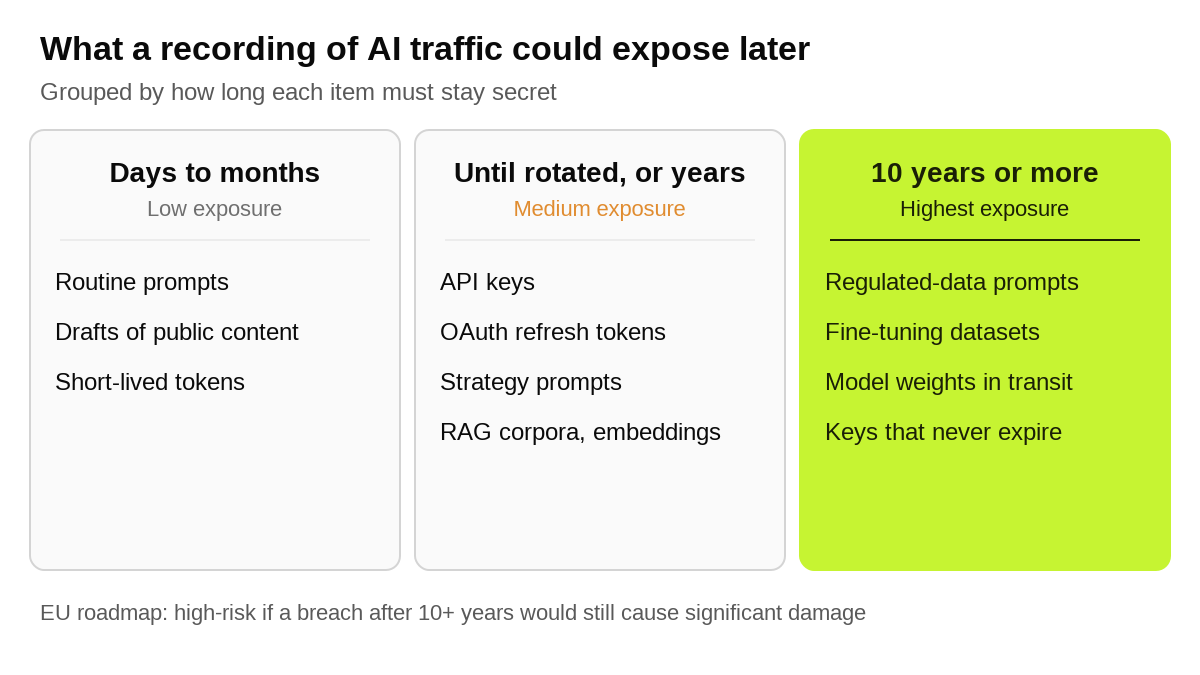
Harvest-now-decrypt-later means an adversary records encrypted traffic today and decrypts it once a large enough quantum computer exists. For AI systems, the exposed material is whatever must stay secret for a long time: prompts that carry regulated or strategic data, RAG corpora and their embeddings, fine-tuning datasets, model weights in transit, and any long-lived credential, such as an API key or OAuth refresh token, that travels inside a recorded session.
Our own test turned up a twist. On 26 November 2026 we checked 37 AI endpoints, and 28 negotiated hybrid post-quantum key exchange (X25519MLKEM768, which pairs classical X25519 with ML-KEM). That includes 12 of 14 model APIs and 6 of 7 chat apps. The weak points sit in between: remote MCP servers (10 of 16), plus the client libraries, scripts and proxies on your side of the connection, because both ends have to agree.
Last verified: 26 November 2026, against NIST, White House, OMB, European Commission, NCSC, OpenSSL and Chrome team publications, all primary. The endpoint and client results are an original AccuroAI test, run once from one location on that date.
Figure 1. The right-hand column is what makes a recording worth keeping; the EU roadmap draws its high-risk line at 10 years.
What does harvest-now-decrypt-later actually expose in an AI stack?
The attack needs a copy of your traffic and time. Copying is cheap.
Time is where AI data differs, so ask how long each item must stay confidential. A prompt asking a model to tidy a press release loses its value the day the release goes out. A prompt carrying a patient history, an acquisition target or unreleased source code may need protecting for a decade. So may the documents your RAG pipeline sends to an embedding API, fine-tuning datasets, and weights moving between a training cluster and a host.
Credentials behave differently. An API key or refresh token stays useful until someone revokes it, so decrypting a recorded session years later can hand over a working key if it never expires. A key rotated every 90 days makes the same recording worthless. That reasoning is ours, drawn from how bearer credentials work.
The EU's coordinated roadmap gives a threshold you can reuse. It treats a use case as high-risk when breaking its confidentiality after 10 years or more would still cause significant damage, and says data that must stay confidential for at least 10 years should be protected against quantum attack by the end of 2030.
One distinction keeps the scope honest. NIST IR 8547 notes that signatures are not vulnerable to harvest-now-decrypt-later. Key exchange is the part that protects recorded traffic, and key exchange is what we tested.
Which AI endpoints already negotiate post-quantum key exchange?
We ran two tests on 26 November 2026 from one network location. Test A used Node.js 24.14.1 with OpenSSL 3.5.5 to open a TLS 1.3 connection to port 443 on each host, with SNI and certificate verification, offering only the hybrid group X25519MLKEM768. A successful handshake can only mean the server supports hybrid post-quantum key exchange. A control handshake offered only classical X25519. Test B used the OpenSSL 3.6.2 s_client with its default groups, which list X25519MLKEM768 first, and recorded the group each server actually chose. Both tests agreed on every host, and Test B resolved the two hosts Test A could not complete.
The limits matter as much as the numbers. One run, one place, one day; other regions may answer differently. Key exchange only: certificates were classical everywhere, so ML-KEM here protects confidentiality, not authentication. We saw the public edge only, not internal hops, data at rest or anyone's plans.
Every endpoint in the right-hand column completed a normal encrypted handshake. Classical key exchange is still the common standard and holds against today's computers. The column records only what each server negotiated on 26 November 2026 from our test location.
The pattern is what stands out. Model APIs and chat apps are nearly all hybrid. Remote MCP servers, the layer that connects agents to SaaS tools, split 10 to 6, and MCP connections often carry long-lived material: OAuth tokens, issue trackers, infrastructure plans, payment data. One provider can also differ by host: the Bedrock runtime endpoint in us-east-1 negotiated X25519, while the AWS MCP endpoint in the same region negotiated X25519MLKEM768.
Figure 2. Remote MCP servers are the group with the most classical connections, even though they often carry OAuth tokens to business systems.
Why does your side of the connection matter as much as the provider's?
TLS key exchange is a negotiation. The client offers groups and the server picks one both support. A provider that supports ML-KEM still ends up on classical key exchange if the caller never offers it.
We showed this on one laptop, pointing five clients at a local server that accepts only X25519MLKEM768. Node.js 24.14.1 (OpenSSL 3.5.5), Homebrew Python 3.12.15 (OpenSSL 3.6.2) and the OpenSSL 3.6.2 s_client all connected. The Python 3.9.6 that ships with macOS (LibreSSL 2.8.3) and the system curl (LibreSSL 3.3.6) failed the handshake. Against a real AI API they would not fail. They would connect quietly with classical key exchange, and no application log would show it.
The deciding factor is the TLS library underneath. The OpenSSL 3.5 release notes (3.5.0 shipped on 8 April 2025) say the default TLS keyshares were changed to offer X25519MLKEM768 and X25519, and that the default supported-groups list now includes and prefers hybrid PQC groups. A runtime linked against an earlier OpenSSL, or against a library without that default, stays classical unless someone configures it.
Browsers moved first, and their experience explains the proxy problem. On 23 May 2024 the Chrome team wrote that Chrome 124 had enabled hybrid Kyber key exchange by default for TLS 1.3 and QUIC on desktop, that the rollout revealed existing bugs in several TLS middlebox products, and that Chrome was offering a temporary enterprise policy to opt out. Google later said Chrome 131 would switch to the standardized ML-KEM. A proxy that terminates TLS and opens a fresh connection upstream uses its own stack for that second leg. If the stack is old, the employee's browser negotiates ML-KEM with the proxy and the proxy negotiates classical key exchange with the AI provider. The upstream leg is the one an adversary would want to record.
OMB Memorandum M-26-15 says the same for US agencies: network infrastructure that terminates TLS, including firewalls, VPN concentrators, cloud gateways and API proxies, must be configured to support PQC-capable key exchange.
In an AI estate the forgotten clients are predictable: scheduled Python jobs, agent containers on old base images, SDKs bundled in desktop tools, local MCP servers and inspection proxies.
Which post-quantum deadlines apply, and who do they bind?
Expert estimates of when a cryptographically relevant quantum computer could exist vary, and NIST IR 8547 says none currently threatens today's security levels. We make no prediction. The dates below are what organizations plan against, each checked at the issuing body.
NIST standards (US federal standards, widely adopted elsewhere). FIPS 203 (ML-KEM), FIPS 204 (ML-DSA) and FIPS 205 (SLH-DSA) were approved on 13 August 2024. NIST selected HQC on 11 March 2025 as a backup to ML-KEM, with a final standard expected in 2027.
NIST IR 8547 (final since 27 October 2026; the November 2024 version was a draft). Quantum-vulnerable public-key algorithms, including RSA and elliptic-curve schemes, are deprecated after 2030 and disallowed under NIST standards after 2035.
Executive Order 14412 (US, signed 22 June 2026; binds federal agencies, not national security systems). High value assets and high impact systems move to PQC key establishment by 31 December 2030 and PQC signatures by 31 December 2031. Through a FAR rule, covered federal contractors must comply with NIST FIPS, including PQC algorithms, by 31 December 2030.
EO 14306 (6 June 2025, amending EO 14144) and OMB M-26-15 (24 June 2026; binds federal agencies). Agencies must support TLS 1.3 or a successor no later than 2 January 2030. The memo's phases run from discovery in 2026 to full migration by 2035.
EU coordinated roadmap (23 June 2025; recommendations to Member States, not a regulation). National roadmaps and first steps by 31 December 2026, high-risk use cases migrated by 31 December 2030, medium-risk ones by 31 December 2035.
UK NCSC timelines (guidance first published 20 March 2025; indicative, not legally binding). Discovery and an initial plan by 2028, highest-priority migrations by 2031, everything migrated by 2035.
We could not open the NSA's CNSA 2.0 documents or the Australian Signals Directorate's guidance from our location on 26 November 2026, so their dates are left out.
For private companies the contractor clause is the line to read twice. This is not legal advice; ask counsel how these documents apply to your contracts.
Does post-quantum matter for model signing and provenance?
Yes, but it is a separate problem. Harvest-now-decrypt-later is about secrecy. The signature risk is sometimes called trust-now-forge-later: once a quantum computer can break a classical signature scheme, someone could forge a signature that verifies against a key you still trust. NIST IR 8547 says signatures are not exposed to harvest-now-decrypt-later but calls the transition urgent anyway, because it takes longer and needs more parties to coordinate.
For AI teams that touches signed model files, provenance records and code signing on agents and tools, where ML-DSA (FIPS 204) and SLH-DSA (FIPS 205) are the standardized replacements. A signature checked today is not undone by a later break, so this sits behind key exchange in the queue.
What should security teams do now?
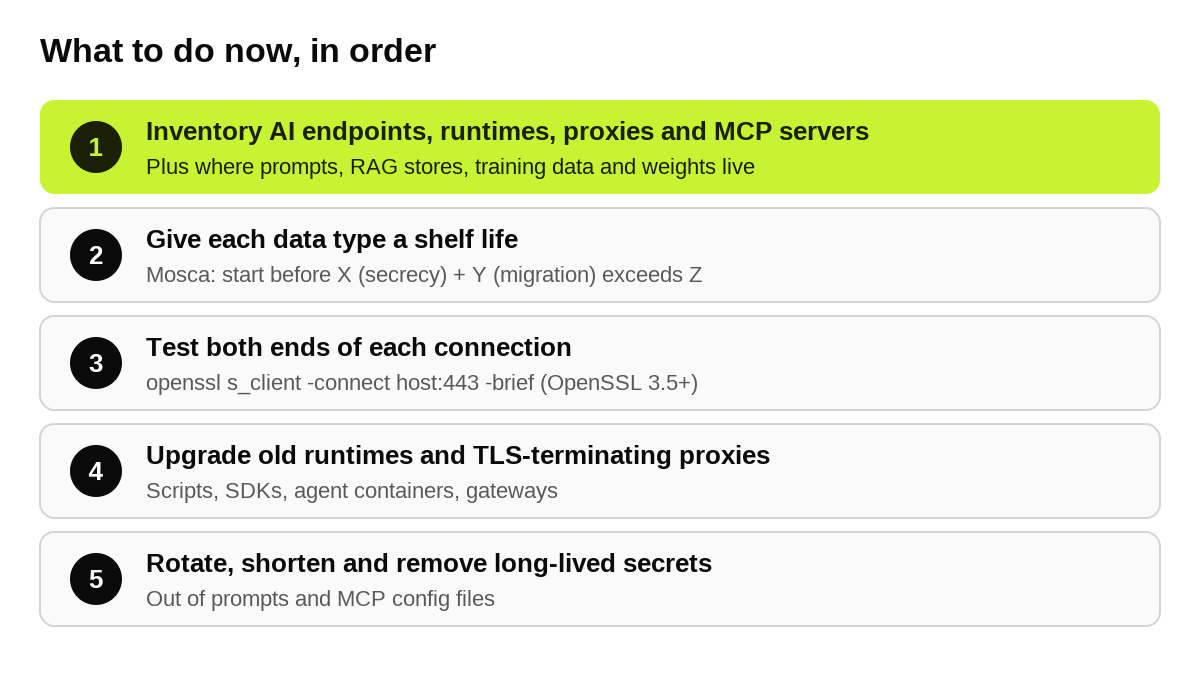
Start with what you can measure this week; the inventory tells you where the rest pays off.
Figure 3. Step one is highlighted because every later step depends on knowing which AI connections exist.
Build an AI-specific crypto inventory. List the AI endpoints in use, the SDK runtimes and TLS libraries that call them, every proxy on the path, local MCP servers, and where prompts, RAG stores, fine-tuning data and weights are kept. Unregistered tools count too; our comparison of shadow AI discovery methods covers how to find them.
Give each data type a shelf life. NIST IR 8547 summarizes Mosca's theorem, named for the cryptographer Michele Mosca: if X is how many years data must stay secure and Y is how long the transition takes, you must start before X plus Y exceeds Z, the expected time until a cryptographically relevant quantum computer is built. You do not need a value for Z to see that a 15-year X is already a planning problem.
Test both ends. Check openssl version first: on macOS the default binary is LibreSSL. With OpenSSL 3.5 or later, run openssl s_client -connect api.example.com:443 -brief (add </dev/null so it exits). The line "Negotiated TLS1.3 group: X25519MLKEM768" means hybrid post-quantum key exchange; "Peer Temp Key: X25519, 253 bits" means classical. Repeat from where AI traffic really leaves: build servers, agent containers, behind the proxy.
Upgrade runtimes and proxies. Move runtimes to OpenSSL 3.5 or later, rebuild agent images, retire system interpreters in scripts, and confirm TLS-terminating gateways offer ML-KEM upstream.
Rotate and shorten long-lived credentials. Prefer short-lived tokens, give API keys expiry dates, and revoke unused refresh tokens. This also limits ordinary leaks.
Keep secrets out of prompts and config files. A key that never enters a session cannot be harvested from it. Our post on how AI coding agents leak secrets shows where they tend to end up. The free MCP Config Scanner flags plaintext tokens in MCP config files right in your browser, and those are exactly the long-lived credentials worth removing.
Ask MCP providers about their plans. For servers that negotiated classical key exchange, ask the provider directly. The MCP Server Risk Directory shows what each popular server lets an agent do, which helps you decide which conversations to have first.
Where can AccuroAI help, and where can it not?
AccuroAI does not make anything quantum-safe, and we do not sell post-quantum cryptography. Key exchange is settled between your TLS libraries and your providers' servers, and upgrading them is engineering work on both sides.
We help around that work. For the inventory, AccuroAI discovers 1,400+ AI tools, which gives you the list of AI endpoints to test. For credentials, it detects 60+ secret types and redacts or blocks them in line before a prompt reaches a model, so a pasted API key never enters the session. And on the path itself, AccuroAI does not use TLS interception and enforces at the point of use, so it adds no proxy hop that re-terminates TLS with its own stack.
No product can tell you how long your data must stay secret. That judgment belongs to data owners.
FAQ
Is our AI traffic already protected against harvest-now-decrypt-later?
Partly. In our test 28 of 37 AI endpoints negotiated X25519MLKEM768 with a current client. Your traffic gets that only if your client, runtime and proxy offer it too.
What is X25519MLKEM768?
A hybrid TLS 1.3 group that runs X25519 and ML-KEM-768 together and feeds both shared secrets into the session keys. NIST IR 8547 describes the goal of hybrid techniques as derived keys that stay secure if at least one component is secure.
Does post-quantum TLS protect what an AI provider stores?
No. It protects data in transit on that connection. Prompts, files and logs a provider keeps are covered by its storage encryption and retention terms, which our test did not examine.
Why did some endpoints negotiate classical key exchange?
We do not know and did not guess. Our test saw only the public edge from one location on one day, and results can change, so ask the provider and retest.