AI Laws That Start 1 January 2027: Colorado, California's Automated-Decision Rules and What to Log Now
Two sets of AI rules start on 1 January 2027: Colorado's SB 26-189 and the ADMT article of California's CCPA regulations, reaching AI used in hiring, lending, housing, education and health care decisions. Each needs an inventory of where AI shapes those decisions, notices and per-decision records. This guide maps every duty to the record that proves it, gives a field-by-field logging spec and a six-week plan to 1 January.
S
Sofia Reyes
Head of Compliance
Nov 17, 2026
On this page
Two sets of AI rules start on 1 January 2027 for companies using automated tools in decisions about people: Colorado's SB 26-189 and the automated decisionmaking technology (ADMT) article of California's CCPA regulations. They reach hiring, lending, housing, education and health care decisions. Have three things ready: an inventory of where AI shapes those decisions, the notices, and the records.
New York's RAISE Act starts the same day, but it binds only frontier model developers.
Six weeks remain. Both states ask what a system did, what the person was told and what happened when they pushed back, and none of that can be rebuilt later.
Last verified: 17 November 2026, against the signed text of SB 26-189 (2026 Session Laws, chapter 131) and the SB 26-189 and HB 26-1263 bill pages on the Colorado General Assembly site, the California Privacy Protection Agency's regulation page and approved regulation text, the New York Senate page for S8828 and the Texas Legislature page for HB 149. Carried from our earlier posts, not re-opened today: Illinois HB 3773's 1 January 2026 start, because the Illinois legislature site refused our connection. We could not open the Colorado Attorney General's rulemaking pages, so the draft rules are not described here.
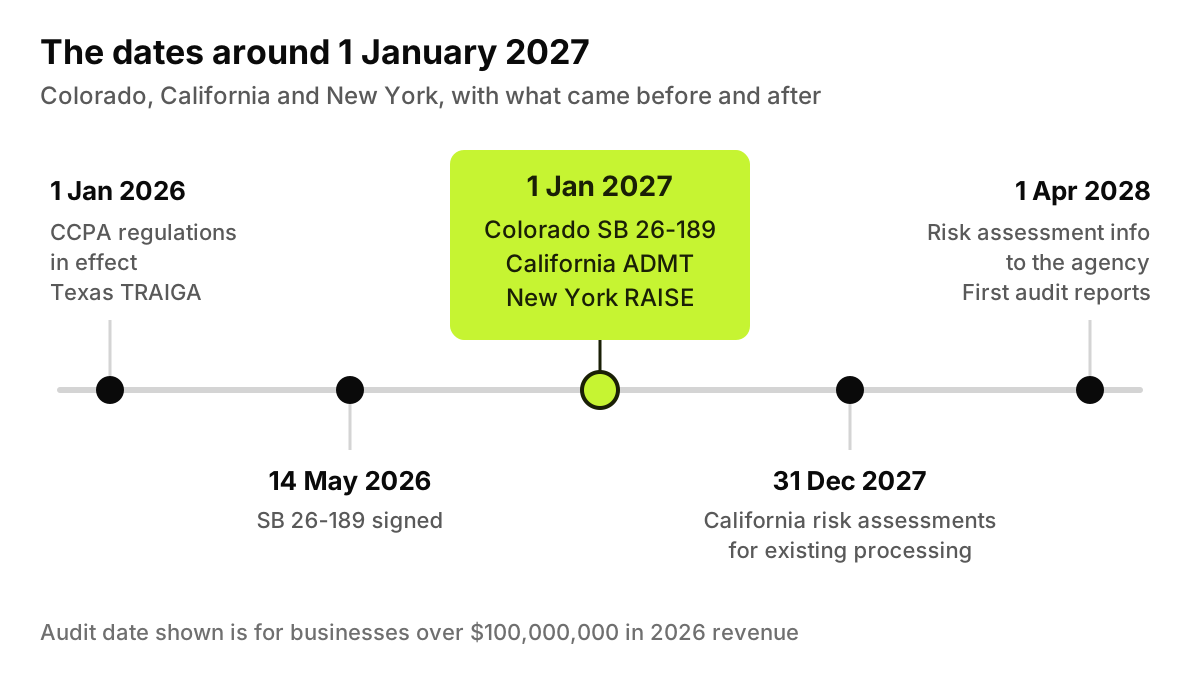
Figure 1. Only one date on this line needs work finished in the next six weeks; the later ones depend on records that start on it.
What starts on 1 January 2027, and what started already?
Colorado's act repeals and reenacts part 17 of article 1 of title 6 of the Colorado Revised Statutes, the part that held the 2024 AI Act (SB 24-205). Section 5 says that, apart from listed provisions, "this act takes effect January 1, 2027", and that it "applies to consequential decisions made on or after January 1, 2027." The exceptions, including the attorney general's rulemaking provisions, took effect at signing on 14 May 2026, which is why the bill page's session-law table shows that date.
California's regulations took effect on 1 January 2026, but section 7200(b) gives the ADMT article its own clock: a business using ADMT for a significant decision before 1 January 2027 "must be in compliance with the requirements of this Article no later than January 1, 2027."
Two narrower laws share the date. New York's S8828, signed on 27 March 2026 as Chapter 96, makes the RAISE Act "take effect JANUARY 1, 2027" for developers of models trained with more than 10^26 operations. Colorado's HB 26-1263 sets duties from the same day for operators of public conversational AI services. Most deployers owe neither.
Some rules are already running. Texas HB 149 (TRAIGA) took effect on 1 January 2026, as did most of California's updated CCPA regulations. Illinois HB 3773, which brings AI in employment decisions under the Illinois Human Rights Act, has applied since 1 January 2026 (carried from our US state AI law tracker).
What does Colorado SB 26-189 require?
The act splits duties between developers and deployers. A deployer is "a person doing business in Colorado that deploys a covered ADMT", and covered ADMT is technology used to "materially influence a consequential decision", meaning its output is a non-de minimis factor that affects the outcome, for example by ranking or scoring. Consequential decisions concern access to, eligibility for, selection for or compensation in education, employment, residential housing, financial or lending services, insurance, health-care services, and essential government services. "Consumer" includes employees and job applicants who are Colorado residents.
Deployer duties:
Notice before use (6-1-1704(1)-(2)): a clear and conspicuous notice, which a prominent public notice at points of interaction can satisfy.
Adverse outcome disclosure (6-1-1704(3)): "within thirty days after making the decision", a plain-language description of the decision and the system's role, how to ask for the system's name, version, developer and the personal data used, and the consumer's rights.
Correction and review on request (6-1-1705): correction of factually incorrect personal data and "an opportunity for meaningful human review and reconsideration", to the extent commercially reasonable.
Records (6-1-1703): kept "for not less than three years after the date of a consequential decision."
Developers owe deployers documentation from 1 January 2027 and notice of material updates, and keep their own records for three years. The attorney general enforces through the Colorado Consumer Protection Act, with a notice of violation and sixty days to cure where a cure is possible until that step is repealed on 1 January 2030. Nothing in the act "creates a new private right of action."
One exclusion matters to anyone whose staff use ChatGPT or Copilot. ADMT does not include natural-language technology that gives information or generates content if it is not marketed or configured for consequential decisions and "is subject to an acceptable use policy that prohibits generated content to be used in a consequential decision." Your acceptable use policy now has a legal job. Whether the exclusion survives an employee who ignores the policy, the text does not say.
What do California's ADMT rules require?
California's trigger is different. ADMT is technology that processes personal information to "replace human decisionmaking or substantially replace human decisionmaking", which happens when output drives a decision without "human involvement": a reviewer who knows how to interpret the output, analyzes it with other relevant information, and has authority to change the decision. A significant decision provides or denies financial or lending services, housing, education enrollment or opportunities, employment or contracting opportunities or compensation, or healthcare services. Insurance is not on the list.
Section 7220 requires a Pre-use Notice at or before collection that states the specific purpose, the opt-out and access rights, and how the ADMT works. Section 7221 requires an opt-out with two or more methods; processing stops within 15 business days of a request. The opt-out can be skipped if the business offers an appeal to a human reviewer with authority to overturn the decision, or, for admission, hiring and work allocation, if the tool is used only for that assessment, works for its purpose and does not unlawfully discriminate. Section 7222 covers access requests, and section 7021 sets the clock for access and appeals: confirm within 10 business days, answer within 45 calendar days, extendable to 90.
Risk assessments and audits run later. Using ADMT for a significant decision needs a risk assessment (section 7150(b)(3)): before new processing starts, or by 31 December 2027 for processing already under way when the regulations took effect. Information on 2026 and 2027 assessments goes to the agency by 1 April 2028. Where a cybersecurity audit is required, the first report is due by 1 April 2028 for businesses with more than $100,000,000 in 2026 revenue, then 2029 and 2030 for smaller tiers.
Which duties need which records?
Law and section
Who it applies to
What you must do by 1 January 2027
The record that proves it
How long to keep it
Colorado, C.R.S. 6-1-1704(1)-(2)
Deployers of covered ADMT
Publish a notice before covered ADMT influences a decision
Notice text, version, location, go-live date
3 years after each decision (6-1-1703)
Colorado, 6-1-1704(3)
Deployers
Be ready to disclose within 30 days of an adverse decision
Decision date, disclosure date and content
3 years after the decision
Colorado, 6-1-1705
Deployers
Route correction and human review requests
Request, reviewer, evidence, outcome
3 years after the decision
Colorado, 6-1-1702
Developers
Give deployers documentation and update notices
Version identifiers, changelogs, notices
3 years after the record is created
California, 11 CCR 7220
Businesses using ADMT for a significant decision
Show a Pre-use Notice at or before collection
Notice version and when it was shown
Not set in the ADMT article
California, 7221
Same
Offer two or more opt-out methods, or document the exception
Request date, stop date, providers told, or exception cited
Not set in the ADMT article
California, 7222 and 7021
Same
Answer access and appeal requests in 45 calendar days
Receipt, confirmation, response, any extension
Not set in the ADMT article
California, 7150 and 7155
Same
Assess new ADMT uses before they start
The risk assessment and its versions
Life of the processing or 5 years after completion, whichever is later
What should you log for every AI-assisted significant decision?
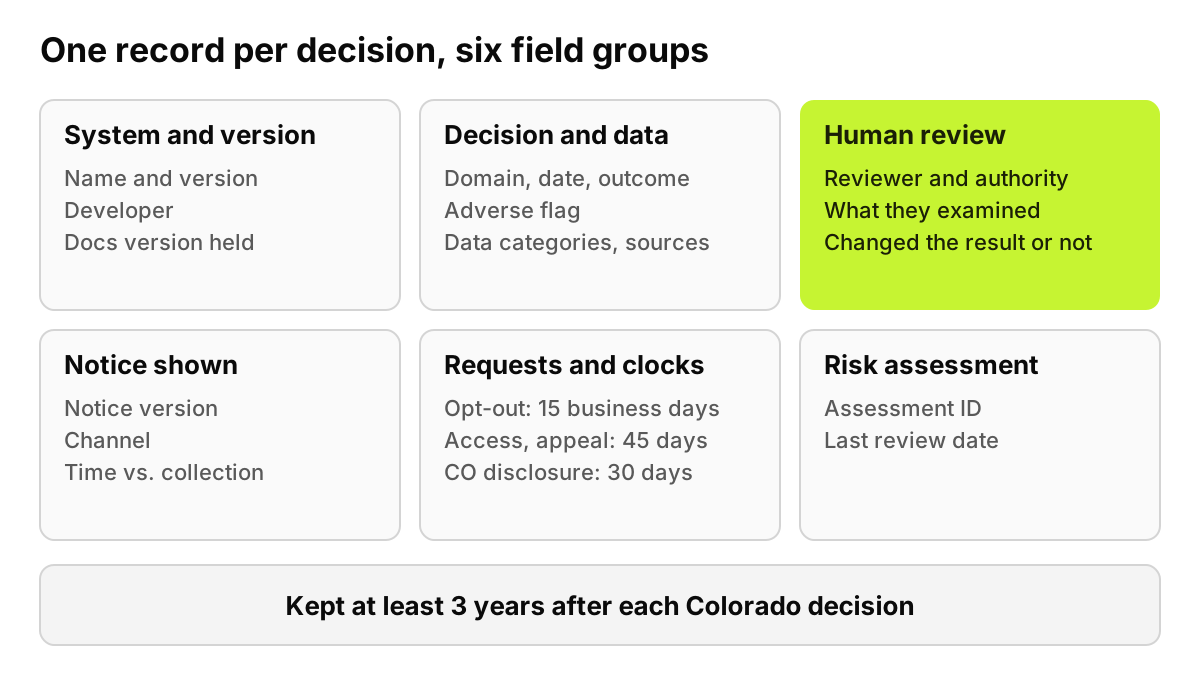
Write one record per decision, not per system:
System and version: name, version number, developer, and the developer documentation version you hold.
Decision type: covered domain or significant decision category, date, outcome, and an adverse flag.
Data categories: the types, categories and sources of personal data used.
Output role: sole factor, one factor among others, or a score a person weighed.
Human review: who reviewed it, whether they could change it, what they looked at, and whether they did. This field decides whether California's ADMT definition applies at all.
Notice: the version shown, the channel and the timestamp relative to collection.
Requests: opt-out, access, appeal, correction and review, with dates received, confirmed and closed, plus the opt-out stop date and the service providers notified.
Adverse outcome disclosure: date sent and days since the decision.
Risk assessment reference: the assessment ID and its last review date.
Figure 2. The human review group carries the most weight, because it settles whether California's ADMT definition is triggered in the first place.
Keep the record where you control retention. A Colorado record written in January 2027 has to survive until at least January 2030.
Why start with general AI usage logs?
You cannot write a notice for an AI use you have not found. Picture Rachel Torres, a recruiter, pasting forty résumés into a personal ChatGPT account and asking it to rank them for a shortlist. If that ranking shapes who gets an interview, it may be the very decision both states care about, and the company has no record of it.
So the first log is plain: who used which AI tool, under which account, with which kinds of data. It will not say whether a use is a consequential decision, but it tells counsel where to look. Shadow IT versus shadow AI explains why procurement records miss them.
A found use has two clean outcomes: move it into an approved system that writes the decision record, or stop it. Blocking the personal account while the licensed tool keeps working is often quickest, as our guide to blocking personal AI accounts shows. The Enterprise AI Acceptable-Use Policy template is worth adapting now, because Colorado's chat-tool exclusion turns on a policy that bars generated content from consequential decisions.
What can you finish in six weeks?
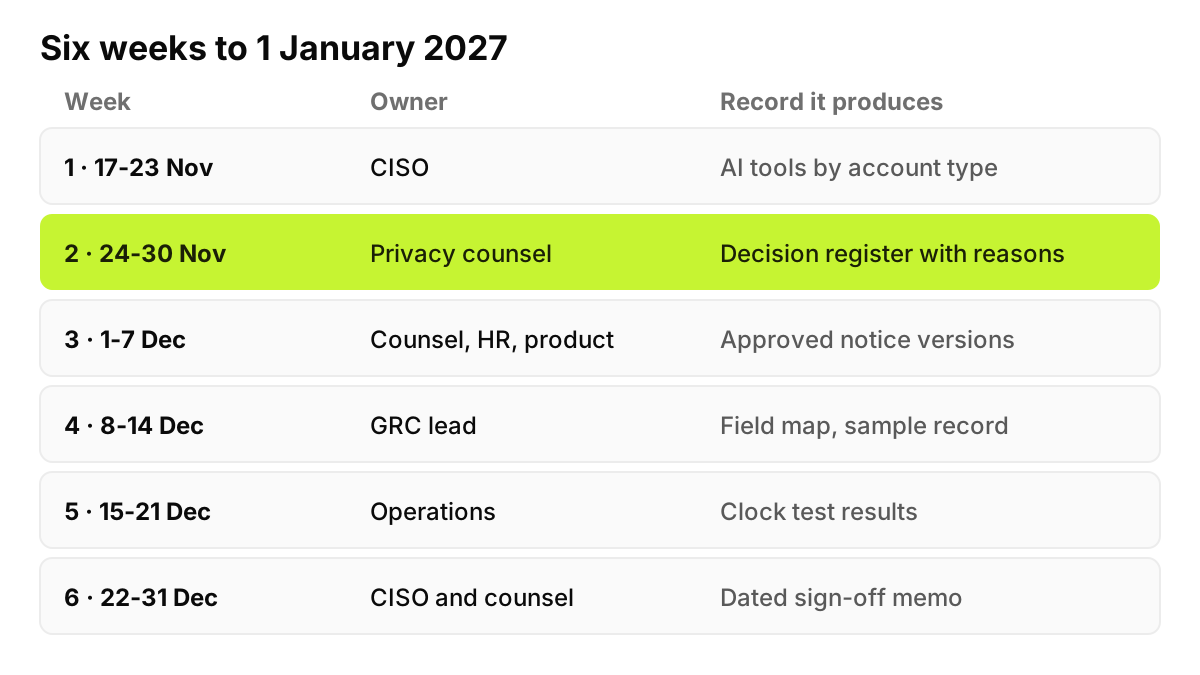
Six weeks and three days separate 17 November from 1 January (our arithmetic). Each week ends with a record.
Week 1, 17 to 23 November. CISO. Turn on AI usage discovery across browsers and managed devices. Record: AI tools in use, by department and account type.
Week 2, 24 to 30 November. Privacy counsel. Sort each use touching hiring, pay, lending, housing, education, insurance or health care into Colorado, California, both or neither. Record: a decision register with reasons.
Week 3, 1 to 7 December. Counsel with HR and product. Draft both notices; choose opt-out or the human appeal exception. Record: approved notice versions.
Week 4, 8 to 14 December. GRC lead. Build the decision record fields into the remaining systems. Record: a field map and a sample record per system.
Week 5, 15 to 21 December. Operations. Wire the 30-day, 15-business-day and 45-day clocks. Record: a test request run through each.
Week 6, 22 to 31 December. CISO and counsel. Publish notices, set retention to at least three years, schedule risk assessments, block uses that failed week 2. Record: a dated sign-off memo.
Figure 3. Week 2 is the judgment call; everything after it assumes counsel has sorted each use.
Software can supply the facts behind weeks 1, 4 and 6. AccuroAI recognizes 1,400+ AI tools in the browser and on managed devices, with the signed-in account (personal or business) and the plan, without TLS interception; shadow AI discovery answers the Rachel Torres question in days. It redacts or blocks personal data in prompts and files before they reach a model, with 40+ classifiers in under 38 ms p99, and blocks personal accounts while the licensed tool keeps working. Audit logs go to your SIEM with evidence mapped to 8 frameworks, and MDM rollout takes under 30 minutes.
It does not write your Colorado notice or your California Pre-use Notice, handle opt-outs or appeals, decide whether a use is a significant or consequential decision, or perform human review. No product makes a company compliant with either law; that takes counsel, the owners of each decision and records your own systems keep.
This post is general information, not legal advice. Confirm how these laws apply to you with your own counsel.
FAQ
Does Colorado's AI law still require impact assessments?
Not in the text that starts on 1 January 2027. SB 26-189 repealed and reenacted the part that held the 2024 act, and the deployer duties are now notice before use, a disclosure within 30 days after an adverse decision, correction and human review on request, and three years of records.
Does using ChatGPT in hiring trigger these rules?
It can. If its ranking materially influences a hiring decision about a Colorado consumer, it may be covered ADMT. In California it is ADMT if it replaces human decisionmaking without qualifying human involvement. Colorado excludes some chat tools covered by a prohibiting acceptable use policy; counsel should confirm how that applies to you.
Is there a private right of action under SB 26-189?
No. The act says nothing in it creates a new private right of action. The attorney general enforces it as a deceptive trade practice, and until 1 January 2030 must first give a notice of violation and sixty days to cure where a cure is possible.
Does human review take a tool outside California's ADMT rules?
It can, if the review meets the regulation's test. The reviewer must know how to interpret the output, analyze it alongside other relevant information, and have authority to make or change the decision. Log those three facts for every decision, because a review missing any of them leaves the tool inside the definition.