How CISOs Make AI Security Succeed in 2027: A Six-Part Operating Plan
CISO AI security succeeds in 2027 when the security leader can say which AI is in use and under which accounts, protect data without stalling adoption, limit what agents may do, produce evidence within days, and fund and report the work. This operating plan gives each of the six parts the board question it answers and the evidence that answers it, then a 90-day sequence with owners and the 2027 dates that will test it.
J
James Okafor
Field CISO
Nov 14, 2026
On this page
CISO AI security succeeds in 2027 when the security leader can do five things on request: say which AI is in use and under which accounts, control data where people use it without stalling adoption, limit what agents may do, produce evidence within days, and fund the work and report it to the board in numbers that hold up.
This post is the operating plan: six parts, the evidence each produces, a 90-day sequence and the 2027 dates that will test it. Our earlier piece on how AI redefined the CISO's role is about the job; this one is about running it.
Before planning, the AI governance maturity assessment scores the program you already have, so the first 90 days go to the weakest part, not the loudest.
Last verified: 14 November 2026, against NIST's AI RMF page, OWASP's LLM and agentic Top 10 pages, the European Commission's AI Act Service Desk (timeline and consolidated Article 113), IBM's Cost of a Data Breach page, the Cloud Security Alliance report page and the Colorado General Assembly page for SB 26-189. EUR-Lex returned only an index page today, so EU dates were read on the Commission's consolidated text. The California and India dates are carried from our compliance calendar of 30 October 2026.
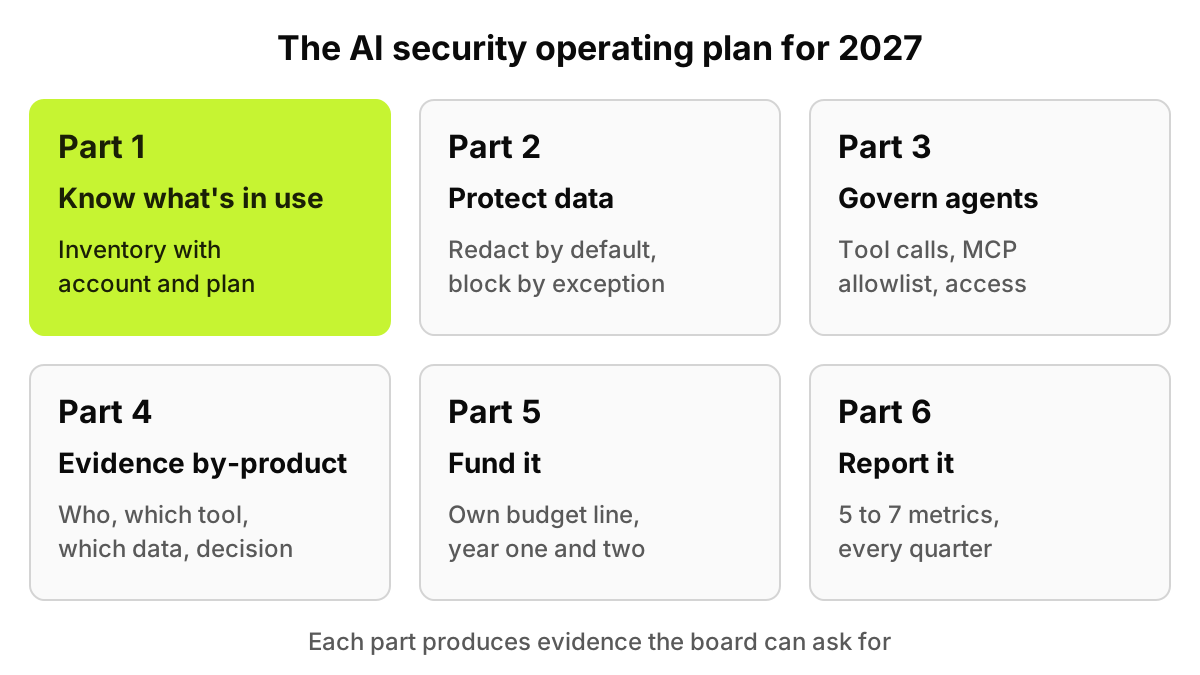
Figure 1. Part 1 is highlighted because the other five depend on the inventory it produces.
What does a successful AI security program look like in 2027?
Six parts, each tied to a question the board will put to you sooner or later.
Part
What success looks like
The question the board will ask
The evidence that answers it
1. Know what's in use
One live inventory of browser AI, desktop apps, coding agents and MCP servers, with account and plan
"What AI is in use here, and how do we know?"
Discovery export: tool, account type, plan, owner, first seen
2. Protect data
Sensitive data redacted by default, blocks kept for named cases, licensed tools working
"Can our data leave through AI, and are we slowing people down?"
Redaction and block events by data type; share of use on business accounts
3. Govern agents
Coding agents limited by role and work account, an MCP allowlist, risky tool calls confirmed or blocked
"What can our agents do without a person approving it?"
Tool-call log with risk grade and decision; allowlist change history
4. Evidence as a by-product
Every event records who, which tool, which data and which decision
"What could we hand a regulator within a week?"
Dated log export mapped to NIST AI RMF functions and EU AI Act duties
5. Fund it
Its own budget line, sized from seats, quotes and hours
"What does this cost, and what does year two cost?"
Line items split one-time and recurring, each tied to a risk or a date
6. Report it
Five to seven metrics with fixed definitions, every quarter
"Is our AI risk going up or down?"
A quarterly pack that shows the trend
In every row, the evidence is something a system produced on its own, not a slide assembled the night before the meeting.
Part 1: what AI is actually in use?
Four surfaces, and most programs see only the first. Browser AI is ChatGPT, Claude, Gemini or Perplexity in a tab. Desktop AI apps are Claude Desktop, the ChatGPT app and Microsoft Copilot. Coding agents are Cursor, Claude Code and GitHub Copilot in an editor or terminal, and then come the MCP servers those agents launch.
An app list misleads in three ways. ChatGPT under a personal free login and ChatGPT under the company workspace look identical on a list of domains, yet the data terms differ completely. Desktop apps sit outside the browser: a proxy that does not decrypt TLS sees a destination, not a prompt, and a laptop on home Wi-Fi may never route through it (our comparison of endpoint, browser and proxy enforcement covers what each layer sees). And MCP servers add capability that the agent's name never reveals.
The gap is common. In an April 2026 survey from the Cloud Security Alliance and Token Security, 82% of organizations discovered previously unknown AI agents in the past year.
Success here is one inventory, refreshed continuously, with an owner per tool and an account type per user. If you cannot produce it in an afternoon, Part 1 is your first month.
Part 2: how do you protect data without killing adoption?
Redact by default. Block only where you have a named reason. Keep licensed tools working.
Block every AI tool and the work does not stop; it moves. Sarah Mitchell in finance still has a forecast to summarize, so she opens a personal account on her phone, and now nothing you run can see what she pasted. If the company workspace works instead, and the account numbers in her prompt are masked before it leaves the laptop, she finishes the task and the data stays home. More in why redaction beats blocking.
Redaction is the default for customer identifiers, account numbers, health and payroll data, and restricted source code. Blocks are for named cases: a personal account on a tool you license, an upload of a restricted file, a tool whose data terms you rejected. Everything else is allowed and logged.
Watch two numbers. The share of AI use on business accounts should rise, and blocks should fall after the first month as people find the sanctioned path. If blocks keep climbing, the policy is fighting the work and people will route around it.
Part 3: how do you govern agents by what they can do, not what they are?
An assistant answers; an agent acts. It reads files, runs commands, calls APIs and edits code, so its product name says little about the risk while its permissions and tool calls say nearly everything.
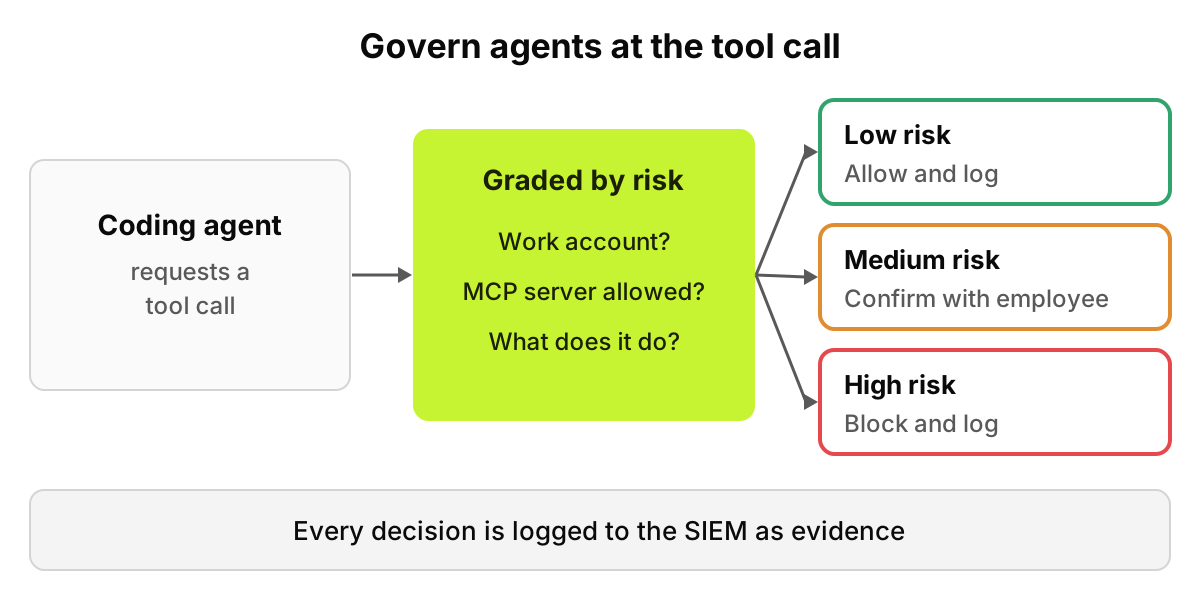
Grade every tool call by risk. Reading a file in the repository is low. A shell command that deletes, pushes to a protected branch or sends data to an outside address is high. Low passes, medium asks the developer to confirm, high is blocked.
Keep an MCP allowlist. When David Kim installs a public server that promises to manage his database, it waits for review instead of running with his credentials.
Control who may use coding agents, by department or role and only on a work account, so single sign-on and offboarding apply. Our table of SSO and SCIM in coding tools shows which plans allow it.
These map onto the OWASP Top 10 for Agentic Applications for 2026, released on 9 December 2025. In our reading, tool-call grading answers ASI02 Tool Misuse and Exploitation and ASI05 Unexpected Code Execution, the allowlist answers ASI04 Agentic Supply Chain Vulnerabilities, and work-account-only access narrows ASI03 Identity and Privilege Abuse. A confirmation step also limits ASI01 Agent Goal Hijack, because a redirected agent still has to make the call. The OWASP Top 10 for LLM Applications names the root problem LLM06:2025 Excessive Agency.
Figure 2. The decision sits at the tool call, so it applies whichever agent made the request.
Part 4: how do you make evidence a by-product?
Evidence should fall out of the controls. If every event already records who (and whether the account was personal or business), which tool and plan, which data types, and which decision with a timestamp, most requests become a query against the SIEM you already run.
Then map once. NIST's AI Risk Management Framework 1.0, released on 26 January 2023 for voluntary use, has four functions: Govern, Map, Measure and Manage. NIST says it is being revised under the White House AI Action Plan. In our own crosswalk, the inventory is Map, logs and metrics are Measure, redact and block decisions are Manage, and named owners are Govern. ISO/IEC 42001 can sit on the same crosswalk; we cite no control numbers. The EU AI Act asks deployers for records too, and its dates are now fixed.
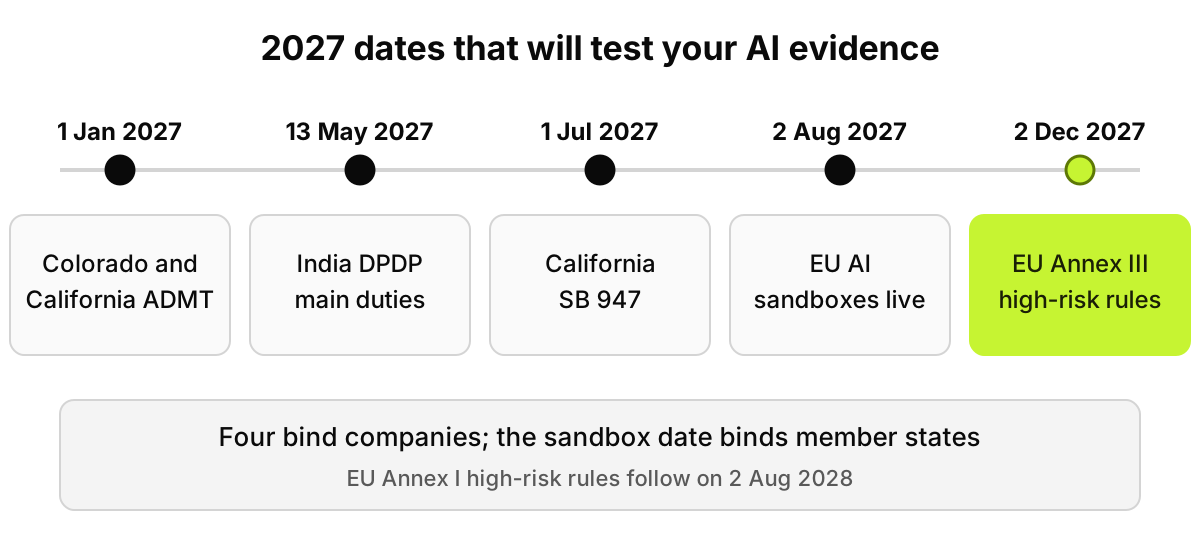
The 2027 dates that will test the evidence:
1 January: Colorado's SB 26-189 on automated decision-making (notice, a disclosure within 30 days of an adverse outcome, three years of records) and California's CCPA rules for automated decisions in significant matters.
13 May: India's DPDP Rules reach every Data Fiduciary, with logs kept for one year (14 May on the Gazette stamp reading).
1 July: California SB 947 on automated decision systems in employment.
2 August: each EU member state should have an AI regulatory sandbox operational.
2 December: EU AI Act rules for Annex III high-risk systems apply; Annex I follows on 2 August 2028.
The EU dates come from Article 113 as amended by the Digital Omnibus on AI, Regulation (EU) 2026/1744. The Commission's consolidated Article 113 and implementation timeline present them as amendments already made, not proposals. Our AI compliance calendar has the full rows and sources.
Figure 3. Four of the five dates bind companies directly and start from an inventory and records; the August date binds EU member states.
The laws and dates in this section are general information, not legal advice; ask counsel how each one applies to your company.
Parts 5 and 6: how do you fund it and report it?
Fund it
Give AI security its own budget line, sized from seat count, written vendor quotes and staff hours. Split year-one costs from what recurs, and tie each item to a named risk or a date from the list above. The AI security budget calculator does the arithmetic, and our guide to writing the 2027 budget line covers the paragraph a CFO reads. When comparing platforms, ask whether pricing is per user or metered; ours is on the pricing page.
Outside figures are context, not the reason. IBM's Cost of a Data Breach Report 2026 puts the global average breach at USD 4.99 million, which IBM calls a 12% increase over last year and a record high.
Report it
Pick five to seven metrics and keep the definitions fixed, because a board reads the trend:
Inventory coverage: tools, agents and MCP servers discovered, against those with an owner.
Business-account share of AI use.
Sensitive-data events per 1,000 users, split into redacted and blocked.
Agent coverage: coding-agent users on work accounts, and MCP servers in use that are on the allowlist.
High-risk tool calls, with the share confirmed or blocked.
Rachel Torres, a deputy CISO at a 6,000-person company, has one quarter before the budget locks. This is her order of work.
Days
What to do
Owner
Evidence produced
0 to 30
Score the program; run discovery across browser, desktop apps, coding agents and MCP servers; name an owner for each tool and each 2027 date
CISO; IT endpoint lead; GRC lead
Baseline maturity score; first inventory export; owner register
31 to 60
Turn on redaction in licensed tools; block personal accounts on them; publish the MCP allowlist; limit coding agents to approved roles; grade tool calls
Security architecture lead; head of engineering
Policy change log; first redaction and block report; allowlist version 1; first tool-call log
61 to 90
Stream events to the SIEM and map them; run a timed evidence request; send the first metric pack; submit the budget line
GRC lead; SOC lead; CISO; finance partner
Mapped log export; drill time in hours; board pack with baselines; budget line
Nothing here waits for a perfect policy, and the day-90 board pack shows a baseline instead of a promise.
Which parts can software carry, and which stay with people?
Software can make Parts 1 to 4 real. AccuroAI recognizes 1,400+ AI tools in the browser and on managed devices, each with the signed-in account (personal or business) and the plan, without TLS interception. It redacts inline with 40+ classifiers in under 38 ms p99, and can block a personal account while the licensed tool keeps working. Every tool call a coding agent makes is graded by risk, then allowed, confirmed with the employee or blocked. MCP servers are inventoried with risk scores and can be blocked across the fleet. Audit logs go to your SIEM, with evidence mapped to 8 frameworks.
It cannot set your risk appetite, decide whether a use case is high-risk under a law, or write the board narrative. Those stay with people. No product makes an organization compliant with any law or standard.
FAQ
What is the first thing a CISO should do about AI security in 2027?
Build the inventory. Redaction rules, board metrics and regulatory evidence all start from knowing which AI tools, agents and MCP servers are in use and under which accounts. A list of approved apps is not enough, because personal accounts, desktop apps and attached MCP servers rarely appear on it.
Should we block ChatGPT and other public AI tools?
Block personal accounts on tools you license, and tools whose data terms you reject. Blocking everything tends to push work onto personal devices where you see nothing. Redacting sensitive data in line keeps the work visible, keeps the data inside, and leaves people a sanctioned path.
How is securing AI agents different from securing employee AI use?
Employee use is mostly about what data goes into a prompt. Agents act on systems, so the control point moves to what they may do: grade each tool call by risk, keep MCP servers on an allowlist, and limit coding agents to approved roles on work accounts.
Which 2027 deadlines matter most for AI security evidence?
For many companies: 1 January (Colorado and California automated decision rules), 13 May (India's DPDP Rules), 1 July (California SB 947) and 2 December (EU Annex III high-risk rules), with Annex I following in August 2028. Which bind you depends on where you operate and how you use AI, so confirm with counsel.
How many AI metrics should go to the board?
Five to seven, with definitions that stay fixed from quarter to quarter. Cover inventory, account type, sensitive-data events, agent controls, high-risk tool calls and time to evidence. Directors read direction more easily than levels, so report the trend and flag any change in a definition.