AI Agent Governance in 2027: Identity, Actions and Context
AI agent governance in 2027 means governing each agent by three properties instead of by product name: whose authority it acts on, what it can change and what it can read and remember. This post compares assistant, coding, in-house and MCP agents on those properties, sets out a one-page governance model with four autonomy levels, and lists the 2027 changes we could date at the source.
A
Atul B
Co-Founder
Nov 16, 2026
On this page
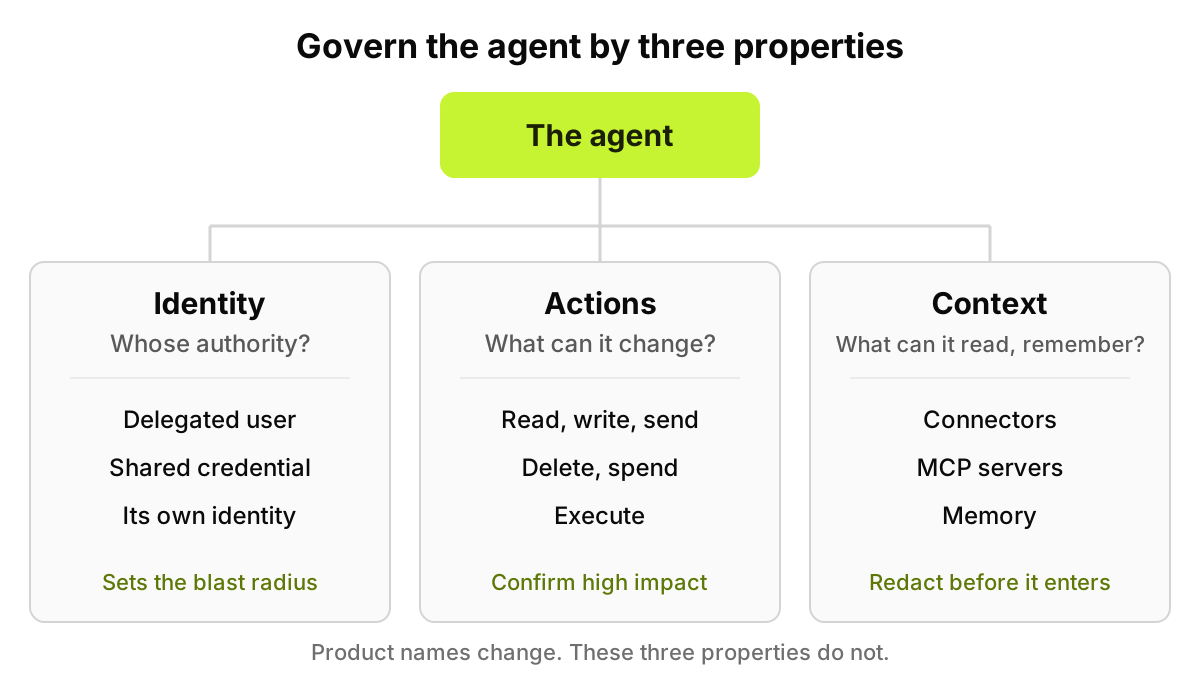
AI agent governance in 2027 means governing each agent by three properties instead of by product name: identity (whose authority it acts on), actions (what it can change, from editing a file to spending money) and context (what it can read and remember). Set a limit on each, confirm high-impact actions with a person, and keep evidence of every decision.
Last verified: 16 November 2026, against the European Commission's AI Act Service Desk (consolidated Article 113), NIST's AI RMF page and AI Agent Standards Initiative announcement, OWASP's agentic Top 10 announcement, Microsoft Learn, the Claude Help Center and Google Cloud's Gemini Enterprise documentation. OpenAI's help center returned an access error today, so ChatGPT agent features are described only in general terms.
Figure 1. The same three questions apply whether the agent lives in an office suite, a terminal or your own code.
Why does governing agents by product name stop working in 2027?
Most 2026 programs governed prompts: what an employee typed into which tool, under which account. That was the right first question, and our operating plan for CISOs in 2027 starts there.
An agent breaks that frame because it acts. One product can host hundreds of agents, each built by a different team with different connectors and rights. Emily Carter in sales operations builds an agent that reads the CRM and drafts renewal emails; her colleague builds one in the same tenant that sends them. Same product, same license, very different risk. A rule written against the product name treats them identically.
In our view, the unit of governance in 2027 moves from the prompt to the agent. Describe the agent by its three properties and the policy carries across products.
Whose authority does the agent act on?
Every agent borrows authority from somewhere, and the source decides the blast radius:
The user's delegated access. The agent reaches only what the person running it can reach.
A shared credential. One key or connection serves every user, so a mistake reaches everything that credential reaches, for everyone, at once.
Its own identity. A registered identity with its own scopes. Cleanest for agents that run unattended, if someone owns and reviews the scopes.
Agent makers document these choices. Microsoft's planning guidance for Copilot extensibility asks builders whether access is "delegated, application-based, service-to-service, or a combination," and says a plugin does not grant a user access to data the user is not otherwise authorized to see. Anthropic's help center makes the same split for Claude connectors: enabling one does not grant anyone access, each person authenticates individually, and access is enforced at the user level. Then the exception, stated plainly: custom connectors that use a shared credential reach whatever that credential can access.
The connector looks the same in the admin console either way.
Issuing agent identities and scoping and rotating their credentials is identity governance work, run by the identity team. AccuroAI does not issue agent identities or manage service accounts or other non-human identities. Security should ask the identity team five things for every agent above the lowest autonomy level:
Which of the three patterns does it use, and who signed off?
What are its exact scopes, and are any wildcard or admin scopes?
Who is the named owner, and what happens when that person moves or leaves?
How long do its tokens live, and can they be revoked in minutes?
Do logs record the agent and the person it acted for as separate fields?
The OWASP Top 10 for Agentic Applications, released on 9 December 2025, calls this risk ASI03 Identity and Privilege Abuse. Our post on zero trust for AI agents explains why human-calibrated controls such as MFA do not carry over to an agent's credentials.
What should an agent be allowed to do?
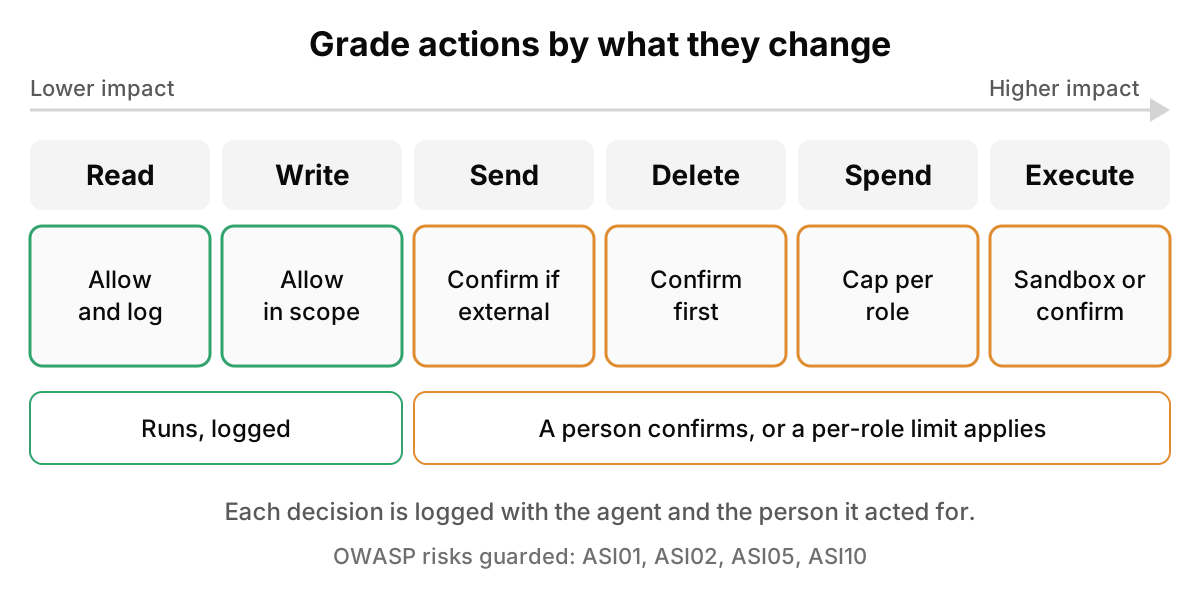
Grade actions by what they change, not by which tool performs them. We use six classes, in rising order of impact: read (open a file, query a record), write (create or edit inside your systems), send (email, messages or API calls that leave the boundary), delete (remove or overwrite, including a force push), spend (purchases, refunds, cloud resources) and execute (run code or shell commands, install packages).
Reads are allowed and logged. Writes are allowed inside the approved scope. Sending outside the company, deleting, spending and executing need a person to confirm, a hard per-role limit, or both. A finance agent might issue refunds up to a set amount for the accounts team and none for anyone else.
Microsoft's guidance names the same family of consequential actions, operations that "create, change, send, approve, purchase, delete, or disclose information," and asks builders to define confirmation and human oversight for each. Some admin switches are coarse. Google's Gemini Enterprise documentation says the mutative action toggle "operates at the connector level," granting the agent every supported write operation for that connector, though adding or updating data through connectors requires human review. In Claude Cowork, the setting that lets members "Always allow" connector tools is off by default, so members approve write-capable connector tools per task.
Confirmation limits ASI01 Agent Goal Hijack, because a redirected agent still has to make the call. The send, delete and execute classes guard against ASI02 Tool Misuse and Exploitation and ASI05 Unexpected Code Execution. Per-role limits that hold whatever the instructions say are the answer to ASI10 Rogue Agents.
Figure 2. Defaults by action class. An autonomy level can tighten any column, but none should loosen the right-hand four for an unattended agent.
What can the agent read and remember?
Context is everything that reaches the agent: connectors to mail, files and CRM, MCP servers, retrieval indexes, and memory that persists between sessions. Connectors and MCP servers decide what it can read. Memory decides what it carries forward.
Both can be poisoned. Microsoft warns that if a custom action supplies data from untrusted sources such as emails or support tickets, an attacker may craft content that makes the agent misbehave or even invoke actions, and advises against giving such an agent sensitive operations without careful human intervention. OWASP files the persistent version under ASI06 Memory & Context Poisoning, and our prompt injection guide covers the indirect attacks.
Three rules hold across platforms. Connect only the sources a task needs. Keep agents that read outsiders' content away from the send, delete, spend and execute classes. And redact sensitive data before it enters context, because whatever goes in can be summarized or sent onward later. Memory, like any data store, needs an owner and a review date.
The token the server holds; a local server runs with the launching user's permissions
Any tool the server exposes, which can change by version
Data the server returns and its tool descriptions
An MCP allowlist and inventory
Owner, risk score, version, approval date
The control point shifts down the table from a vendor's console to your own code.
Where do coding agents fit?
Coding agents act with a developer's account on a machine full of credentials, and their typical actions are the riskiest classes. Our companion post on controlling AI coding agents in Claude Code, Cursor, Codex and GitHub Copilot covers each tool's managed settings, permission rules, sandboxes and MCP controls.
What actually changes in 2027?
Only these are dated at the source today:
2 December 2027: EU AI Act rules for Annex III high-risk systems. The Commission's consolidated Article 113, which shows the amendments made by the Digital Omnibus on AI, sets that date for systems classified high-risk under Article 6(2) and Annex III; Annex I systems follow on 2 August 2028.
The NIST AI RMF is being revised. NIST's AI RMF page says version 1.0, released on 26 January 2023 for voluntary use, "is being revised as part of the White House AI Action Plan." It gives no completion date.
NIST's agent standards work is under way. NIST's Center for AI Standards and Innovation launched the AI Agent Standards Initiative on 17 February 2026, with agent security and identity research among its three pillars. We found no 2027 deliverable date on NIST's pages.
Voluntary frameworks count too: our map of Singapore's agentic AI governance framework shows one government turning identity, scoped authority and human checkpoints into controls. The legal dates here are general information, not legal advice.
What does a one-page agent governance model look like?
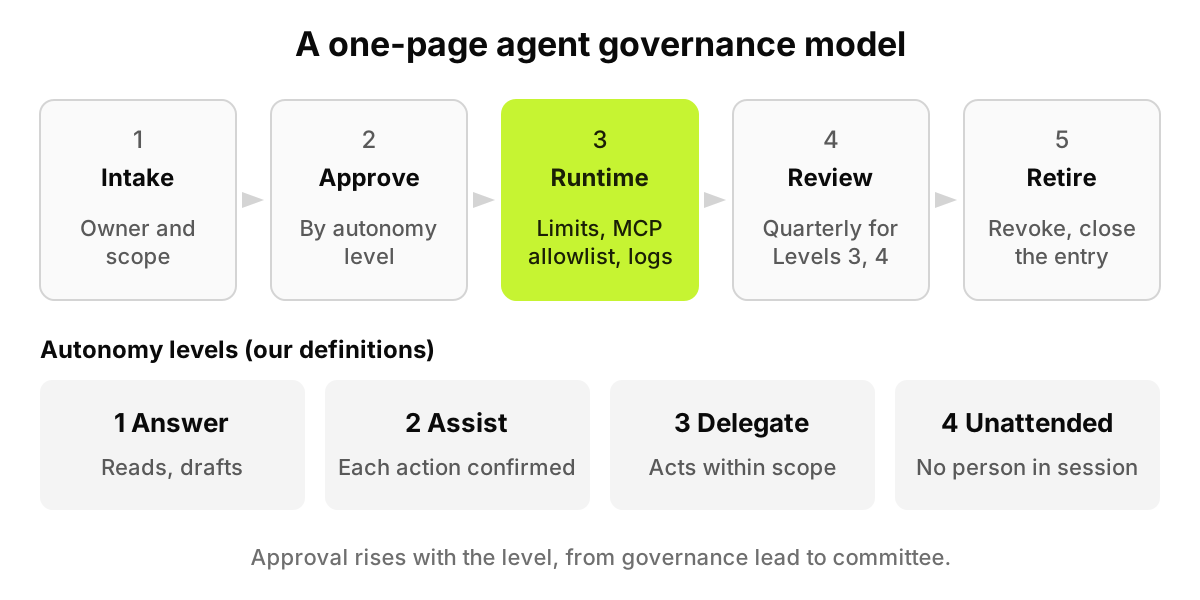
Five stages, one owner each, short enough that people follow it.
1. Intake. Register every agent before production: platform, business and technical owner, identity pattern, connectors and MCP servers, action classes requested, data touched. No named owner, no launch.
2. Approval by autonomy level. The four levels are our own definitions. Level 1, answer: reads and drafts, takes no action; the governance lead approves on a fast track. Level 2, assist: acts, but a person confirms each action; governance lead plus a connector review. Level 3, delegate: acts within an approved scope, with send, delete, spend and execute still confirmed; committee approval. Level 4, unattended: runs on a trigger with nobody in the session, its own identity and an on-call owner; committee approval with identity and security architecture sign-off. Our AI governance committee charter is a useful start for the committee, because its intake form, RACI for approvals and decision log already give each agent decision a written record.
3. Runtime controls. Platform approval settings, per-role action limits, an MCP allowlist, redaction of sensitive data and a log of every high-impact action.
4. Review. Quarterly for Levels 3 and 4, twice a year for the rest, and whenever the owner, a connector or the model changes.
5. Decommissioning. Revoke credentials, disconnect connectors, archive or delete memory, and close the register entry with a date. Forgotten agents keep working.
Figure 3. Runtime controls are highlighted because they are the only stage that runs every time the agent acts.
What should you do in the next 90 days?
List every agent across AI platforms, coding tools and MCP servers, each with an owner.
Record each agent's identity pattern and send shared-credential cases to the identity team with the five questions.
Check each licensed platform's default approval and connector settings against your levels.
Assign autonomy levels and take Level 3 and 4 agents to committee.
Turn on redaction in prompts and files, and publish an MCP allowlist.
Stream agent events to your SIEM so reviews have something to compare.
When you evaluate agent platforms or agent security, keep the AI agent security RFP template open: its 45 scored questions map to OWASP ASI01 to ASI10, so vendor answers line up against the same risks used here.
What can software do here, and what stays with people?
Software can enforce much of the actions and context columns where employees and their agents work. AccuroAI grades every tool call a coding agent makes by risk, then allows it, confirms it with the employee, or blocks it. AI Agent Access blocks coding agents for selected departments or roles, or allows them only on a work account. MCP servers are inventoried with 0 to 100 risk scores and can be blocked across the fleet. Inline redaction with 40+ classifiers runs in under 38 ms p99, removing sensitive data before it reaches an agent. Each event lands in your SIEM as audit evidence mapped to 8 frameworks. See the AI agent security product page.
The rest stays elsewhere. Identity governance issues and scopes agent identities. Platform admins own vendor tenant settings. Engineering owns approval steps inside in-house agents. People set the autonomy level and risk appetite and decide whether a use is high-risk under a law. No software, ours included, makes a company compliant with a law or standard.
FAQ
What is AI agent governance?
It is the set of rules, owners and controls that decide what an AI agent may do on a company's behalf. In our model it covers identity (whose authority the agent uses), actions (what it can change) and context (what it can read and remember), plus evidence that each limit held.
Who should own agent identities?
The identity team, on your identity provider and cloud platforms. They decide whether an agent uses delegated access, a shared credential or its own identity, and they set and rotate scopes. Security and GRC should ask for the owner, the scopes, the token lifetime and logs that separate the agent from the person it acted for.
Which agent actions need human approval?
Anything that sends data outside the company, deletes or overwrites, spends money or executes code. Add per-role limits too, so even a confirmed action cannot exceed what that role may do, such as a refund ceiling.
How do you govern MCP servers?
Treat each one as a new source of actions and context. Keep an inventory with owner, version and risk score, approve servers before use, and block the rest. A server's tools can change between versions, so re-review on every update.
Does the EU AI Act regulate AI agents directly?
The Act regulates AI systems by use and risk, not by the word "agent." An agent used for an Annex III purpose, such as screening job applicants, falls under the high-risk rules that apply from 2 December 2027 under Article 113 as amended. Ask counsel how your uses are classified.